Rachel Goodyear – They never run, only call

Rachel Goodyear – They never run, only call
24th January – 7th March 2009
Wednesday – Saturday 12pm – 5pm
The International 3
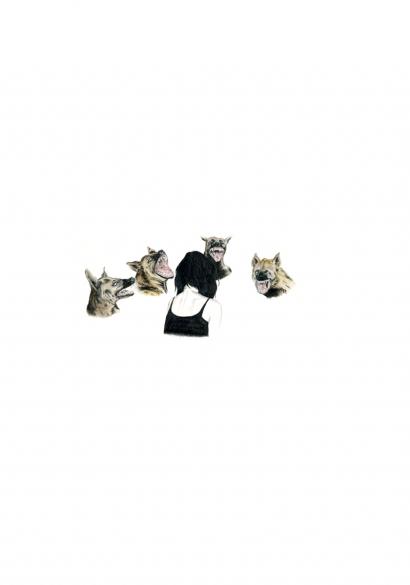
This is the second exhibition Rachel Goodyear has given in Manchester in as many months, the last one at the Cornerhouse with The Intertwining Line, where she exhibited with other artists. I meant to blog on it but never got round to it (naughty me!) Anyway, I became interested in Goodyear’s work there and decided to pop along to The International 3 to see her latest work.

Goodyear draws, in graphite and ink, small intimate pictures of people and animals, and the natural world usually entwined in ambiguous moments, that was the impression I had going to this exhibition, and my imagination wasn’t disappointed. On leaving I did a word association game in my mind to try and distil some of what I had just seen. I came up with ‘isolation’, ‘void’, ‘unprotected’, ‘suggestive’, ‘technical’, ‘mythology’, ‘miniature’, and ‘sightless’, among other words, and these words, or the impression they give, sums up Goodyear’s recent work for me.

I attended a talk that Goodyear gave at the Cornerhouse to accompany her art in The Intertwining Line so I already knew that she was interested in concepts like the void and isolation. But I think that any viewer of her work can come to this conclusion, I get it initially from the medium her work is presented in: white paper with minimal pencil or pen drawings. We get pictures of dogs, people, birds and wolfs, alone or in groups, branches reaching out, insects invading, and it becomes clear to me that they cannot be ‘isolated’, that there is always something going on, an interaction of some sort, no the feeling that is inspired is vacuum, or maybe ennui and a sense of aloneness, extenuating the space between, as no phenomenon is in isolation. I am making a philosophical point here, ‘isolation’ is a word misused in much the same way that ‘nothingness’ is misused, as, strictly being, there is no such thing as ‘isolation’ or ‘nothingness’, there always being something. It is impossible to represent ‘isolation’ one can only approximate something similar to it, say, a vacuum: that is: ‘a region containing no matter, free space’. Scientists can measure vacuums because they can be compared with what is around them (a region), ‘isolation’ on its literal meaning (‘without regards to context, similar matters’), cannot be measured and, therefore, cannot be known.

I digress, it is a bit of a bug-bear with me as I have a phenomenological theory that ‘no phenomenon is in isolation’ because no thing has ever come from nothing…………(I’ll leave that for another post); but what these thoughts bring to my impression of Goodyear’s art do tally with something she has said about her work, the unprotected nature of what she does and what she represents: “Drawing manifests itself upon paper or the manipulation of found objects, all displayed unprotected, offering no evident elevation of status from conception to display.” (from this website) We get this unprotected narrative, look at Girl who smiles at dogs, 2008, four dogs in a semi-circle (Alsations?) facing us snarling, teeth showing. There is a woman’s back, shoulders and head facing us, we must assume her condition, fear? terror? or something malevolent, “a look of ghastly, twisted satisfaction on her face.” as the exhibition leaflet says. That’s the point, its unprotected, and to a degree, sightless: when the eyes are not facing us, they are either physically missing, altered in some way or misplaced as in Making new acquaintances, 2009. This art is very suggestive, presented on the walls with no accompanying titles (though they are all titled) they can be viewed with your own fantasies in mind. The titles, when you come to them, are straight-forward, descriptive titles that leave no room to dream…….Stags with dark eyes……Girl through a hoop……….Dog digging…….yet every single image leaves questions (unprotected?), why is she doing that? what does it mean? why are they interacting like that? There is no obvious narrative.

Or maybe the narrative is fantastical and mythological? On the face of it, of course we’re in some sort of fantasy when we view these pictures, they’re so unreal, everyday objects (people, animals, trees, ect) taken out of an everyday context, with interactions between man and animal, incongruent relations…….ah, now we’re in the realm of myths. Traditional definitions tell me that a myth contains super-human beings, determined in an earlier age, a pre-literate age, that natural phenomenons are interpreted by such fantastical creatures. or that the myth is a theme or character-type that represents an idea. Goodyear’s myths should be treated as similes, that is the drawings, like a figure of speech, resembling one thing in order to represent something other, of a different category. We get a sense of this in the graphite scene, Cave that Coughed, where out of the white void comes a cave entrance spitting out some twisted branch on which resides a wolf, snakes, some birds, one of which is falling off. The exhibition curator, Angela Kingston, in her explanatory notes, refers to Jung’s interpretation of a dream he had about a cave: “Jung interpreted the cave in his dream as a passage to the unconscious.” She should know that this ‘interpretation’ was actually Jung’s interpretation/use of Plato’s Cave Analogy, inverted: while Plato wished to show the ‘real world’ to the cave dwellers by leading them from the cave and into the light of the sun, explaining that to begin with the brightness of the sun (true knowledge, which comes from the Forms) would make it hard to see, Jung was interested in the psychological aspects of the dark, the unconscious. Truth is to be found in the recesses, of the mind as well as in nature. (Another bug-bear of mine is that, philosophically and phenomenologically speaking, there is no such thing as the ‘unconscious’, what is meant by this word is ‘repressed memory’, it being impossible to ‘unconsciously recognise the unconscious’, no we forget conscious moments.) Goodyear provides another interpretation bringing in the thought of co-existence and evolution: how do these animals live (and evolve) together in a cave, this wolf, snake and birds?

And this is what I like from art, the posing, the disputes over meaning, but there is also beauty involved, a technical element that pleases. These are delicately drawn illustrations that show technical virtuosity, with a naturalist’s eye for detail. Close up viewing is required and this takes me back to the minimal presentation of these drawings, their focused nature: the surrounding void focusses the eye. I am also reminded of Goya’s engravings, individual moments of madness frozen in time, the sense of abuse, the implied torment that some of Goodyear’s characters go through, we see women in unnatural positions, with physical abnormalities, alien-like growths………where do we go from here? To the art gallery, I say.
Holman Hunt and the Pre-Raphaelite Vision

Holman Hunt and the Pre-Raphaelite Vision
Saturday 11 October 2008 – Sunday 11 January 2009
Manchester Art Gallery

I should like this stuff, it’s medium is oil on canvas (for the most part), with a healthy splattering of colour and they even try to explore a narrative, yet Pre-Raphaelite paintings leave me cold. As a contemporary comparison, Impressionist paintings do not leave me cold and it is their lack of morality and their profound interest in representing nature truthfully (and aesthetically) that warms me every time I view them.

So, what is it about the Pre-Raphaelite’s that I’m sceptical about? A quote from Holman Hunt himself goes some way to explaining my troubles with the Pre-Raphaelite movement:

“Painters should go out….like merchants of nature, and bring home precious merchandise in faithful pictures….with something like the spirit of Apostles, fearing nothing, going amongst robbers and in deserts with impunity as men without anything to lose.”

Nothing in life is disinterested and having spiritual impulses should not necessaryly detract from a work of art, but this quote shouldn’t hide the propaganda behind such images, and nor should such “merchants of nature” be considered as representing nature truthfully, they do not, they represent a cultural imposition: not the method, just the message.

For Holman Hunt and the Pre-Raphaelites, nature is sick – you see this in the paintings on display in this exhibition, the representation of torment that can only be relieved by the Christian promise – the colours of life are garish, there is an imbalance somewhere. This ‘sickness’ we see in The Scapegoat with its other-worldly dusk and wobbly, symbolic goat. This symbolism and ‘other-worldliness’ reaches a disturbing conclusion with The Triumph of the Innocents, this image of children fleeing Herod’s infanticide with Mary, Joseph and Jesus is disturbing, not because of the subject matter, but rather because of the picture itself: frankly the infants look demonic and this is probably an insight into the perverse relationship the British have with children. These demonic ‘cherubs’ are far removed from Botticelli’s puttos, they don’t seem to belong in the scene that is painted. While the rounded infants found in Botticelli’s work can provoke they are also evanescent, captured with delicacy.

Tom Lubbock in the Independent expressed what I felt walking through this exhibition:

“He oppresses on three fronts. Symbolism. Moralism. Materiality. In a Hunt painting, every detail signifies something. It preaches a lesson. And most oppressively it has a solid, glistening physical presence.”

His work is too ‘heavy’, especially the palette with its bold, contrasting colours. Above I said that Pre-Raphaelite paintings leave me cold while Impressionist paintings don’t. Yes Monet’s palette contains bold, contrasting colours, but he used them in a much less incongruent way, leaving a more natural impression. With Hunt (and the other Pre-Raphaelite painters) there is, I think, an unintended dissonance between their depiction of nature and their ‘moral message’ super-imposed over the paintings – unintended to the modern viewer, at least. No doubt their way of representing nature ‘truthfully’ came at the insistent call of their Christian philosophy.

All in all, I won’t deny that these paintings hold interest but they are not profound, they are too circumstantial for that, historical paintings with too much baggage that instigates their origin.

Democracy or Not?

If you had everything you need and were happy would you care whether you lived under a democratic system or not? Obviously the question already implies that a non-democratic system can provide for your needs and well-being, let’s go with that for a moment. Is it the case that all totalitarian societies now and in the past only provided for a privileged few? What if you were one of the privileged few, would you care about the starving masses, if there were any? What I am proposing is that as long as certain things are in place it doesn’t matter if the form of government is democratic or not.

Does a certain standard of living negate ‘ideology’ and/or lesson a certain ‘psychology’? That is, the psychology to believe in a better way or maybe this psychological urge is diminished by an all-rounded satiation? It was clear that in the former Soviet Union this all-rounded satiation did not exist, but what if it had? One thing I notice is that a consumer society is prerequisite for that same society to ossify, bloat and for complacency to set in. This is the ‘bread and circuses’ that keep the populace from rioting. Yet this certain standard of living that consumer societies get also breeds an acceptance of fascism, whether acceptance through ignorance or because people really are fascists once they ‘own’ a few things like children and property, I don’t know, they are both involved, probably.

Why am I asking these questions? Well it may not surprise some of you that I am not convinced by our modern-day democracy, indeed I’m not convinced that we have ‘democracy’ at all even though we are allowed to vote. Obviously I’m happier to sit here in Britain typing this out for my blog and not be somewhere like the former Soviet Union scrabbling for my daily bread, but I’m not sure that this relative consumer comfort I/we have is a result of ‘democracy’, after all Saudi Arabia has shopping malls and it is far from a democratic state (and for those who live in Saudi Arabia who can take advantage of the shopping malls, does it matter if others can’t?). No, it is my belief that there is something rotten in our democratic system today. Most Western states are governed by Representative democracy, that means we delegate the running of the state to professional politicians, voting for them every few years or so. Today in Britain rarely does a local or general election garner more than 50% turn out, why is this? Personally my vote is wasted because of the constituency I live in: the only choice is for one of the three main political parties of which only the same one will win every time. None of these parties represent even a little of what I believe in, I am effectively disenfranchised. I’m sure this is the case for many people, but another reason given for such low turn outs is that people are happy with the way things are. For some this is true, but this proposition highlights a far more interesting phenomenon: the soporific nature of our consumer culture. Why bother to vote when you can shop. Like Pak-man munching pills we are addicted to our way of life, we can’t participate in democratic life other than by voting every now and then because we are too busy working in order to participate in the consumer merry-go-round (not the building of societies), and the cycle starts again like Sisyphus rolling his rock, on and on. The professional politicians are rubbing their hands with glee at this status-quo, giving themselves pay rises and riding the gravy train to the promise land (wherever the next G8 summit is to be held!).

The main stream media, in Anglo-Saxon states at least, is shockingly appalling. To say that, rather than being an essential organ that uncovers the truth about our governing system, the media are complicit enablers in the status-quo, colluding to disfigure events and, ultimately, the truth, is not over the top in any way. Over time the media has become a font of public relations for those in power, and since we delegate the responsibility of running the state to professional politicians we need the media to report truthfully and with no hidden agendas more than ever, but rarely are there questions about Iraq or the erosion of civil liberties that is now taking place in Britain (for example), instead we get ‘statements’ from the principal agents involved with the running of things: we are told alright! Of course there are exceptions in the media, sometimes you come across articles by journalists that do ask uncomfortable questions. A recent article by Phil Hall in the Guardian (scary name for a paper that, what are they guarding, for who and from whom?) titled ‘Is Britain on the slippery slope to dictatorship? The democracy-loving British public would never put up with dictatorship – or would they?’ asked whether Britain is slipping into a form of dictatorship (elective dictatorship: the root of all fascism?) and presented a list of warning signs that are recognised in other dictatorships. I reprint these warning signs here for your delectation:

  • Inconvenient elections are avoided in the name of getting on with the job.
  • Leaders of the opposition are character-assassinated by the state media.
  • Institutions like the legislature begin to lose their independence and traditional role.
  • Citizens are increasingly afraid to speak openly on certain issues.
  • Citizens are observed and monitored on cameras and the government can tap into their conversations at will.
  • Governments can snatch anyone from their homes or off the street and detain them without trial on charges of treason or terrorism.
  • Ethnic and religious minorities are persecuted and are made into scapegoats.
  • The state increasingly intervenes in family and community life in an attempt to control citizens’ behaviour.
  • The focus of discussion moves away from the issues and into a narrative of political rivalries and gossip spreads.
  • Governments use bread and circuses to shut people up and distract attention away from their increasing political impotence.
  • Public spaces for demonstrations are closed down and restricted.
  • Large and ridiculous monuments are built to impress the citizens.
  • Individuals have to carry ID with them at all times and the government holds large amounts of information on every citizen.

Do any of you believe that these events are happening now? Do you care even if they are? Do you wish them realised if they are not happening now? Are you who Pastor Martin Niemöller was writing about? (There is more than a kernel of truth in his poem, there’s a whole Big Bang in it.) It seems to me that democracy has no problems with the above warning signs, if the people want them, then that’s democratic, right?

To wrap up these thoughts I would like to discuss Nietzsche’s Reality principal. In Twilight of the Idols there is a section called ‘How the ‘real world’ at last Became a Myth’. The long and the short of it is that power determines and defines what is real, this is ‘reality’. Before looking at this section it would be instructive to read a few words from the Nietzsche scholar Pierre Klossowsky. In Nietzsche and the Vicious Circle he explains Nietzsche’s Reality principal and the two sides of its determination:

“Either Nietzsche was delirious from the outset in even wanting to attack these authorities; or else he was clear-sighted in attacking the very notion of lucidity [or the notion of the noumenon itself, my note] directly. This is why, at every step, Nietzsche’s thought found itself circumscribed:

on the inside:
by the principal of identity on which language (the code of everyday signs) [or semiotics] depends, in accordance with the reality principal;

on the outside:
by competent institutional authorities (the historians of philosophy), but also and above all by the psychiatrists, the surveyors of the unconscious who, for this very reason, control the more or less variable range of the reality principal, to which the person who thinks or acts would bear witness;
on both sides, by science and its experimentations, which sometimes separates and sometimes brings the two together, thus displacing the boundaries and ‘adjusting’ the demarcations between the inside and the outside.” (Nietzsche and the Vicious Circle, Pierre Klossowsky, Athlone, 1997. P. xvii-xviii.)

It is the outside bit that I find relevant to this discussion: for ‘psychiatrists, the surveyors of the unconscious’ read modern day politicians and the media-military-industrial complex who, because they have the power, can dictate not only what is ‘real’ but also the attainment of ‘the real’: thus we vote when the system tells us to. So in Twilight of the Idols Nietzsche writes: The real world, unattainable for the moment, but promised to the wise, the pious, the virtuous man……… [I interpret this as being the unquestioning democratic citizen] and later: The real world – unattainable? Unattained, at any rate. And if unattained also unknown. Consequently also no consolation, no redemption, no duty: how could we have a duty towards something unknown?

Indeed, only power can define what this ‘duty’ is, only power determines the various ‘duties’ we are allowed to vote for every few years. We may believe that democracy gives its supporters freedom but it doesn’t, it only allows us certain actions and even these are circumscribed: not everyone can shop in shopping malls or fly in planes or acquire the latest gadget developed from science and technology. Surely a democracy needs to be populated by individuals who are all fully informed and politically involved, not populated by spoilt kids at the candy store?