…our standing has an enviable reputation for disinterest and impartiality in our reporting…
Whoever believes in that anymore, that one can be‘disinterested’ when engaging in something, anything? Its almost as though we are talking about a cognisant corpse whose ‘blood runs cold’ while making judgements. The inner core temperature of humans is 98.F, not exactly cold. Yes its a metaphor but it also hides the unconscious thought that, being civilised we are all rational calculating machines in every situation. This is something we have learned over millennia of cultivation, self-cultivation. The true animal inside us now only exists in an archaic hall of mirrors cropping up in our dreams, or sometimes ‘real’ life. In our early evolutionary existence we had very different emotions than we have today, though they’re part of us, a phylogenetic inheritance that we can only deny and censor.
Isn’t it more like this:
Does nature not remain silent about almost everything, even about our bodies, banishing and enclosing us within a proud, illusory consciousness, far away from the twists and turns of the bowels, the rapid flow of the blood stream and the complicated tremblings of the nerve-fibres? Nature has thrown away the key, and woe betide fateful curiosity should it ever succeed in peering through a crack in the chamber of consciousness, out and down into the depths, and thus gain an intimation of the fact that humanity, in the indifference of its ignorance, rests on the pitiless, the greedy, the insatiable, the murderous.
Friedrich Nietzsche, ‘On Truth and Lying in a Non-Moral Sense’
These antique, archaic remnants are no less the foundation of all humanity, but are the foundations of all civilisations. The greedy acquisitions, the double-crossing, the murders and appropriations of land, resources, people, the air we breathe. Yes, even the air that we breathe, it is the one resource that we can’t quantify no matter our pride; or because of our pride, we can’t give any value to it because we just don’t see it as stuff. This self-interest is also at the heart of our morality, we are social creatures of reputation with nay a disinterested bone in our body.
Okay so this won the Booker prize and has a multitude of positive reviews, but I couldn’t finish it. Briefly, its the story of a spirit-child who is born for a short while in the real world but who’s command is to return to the spirit world when still a child. The child disobeys and wishes to stay in the real world (I’m reminded of Wim Wenders’ Wings of Desire and Far Away, So Close, as a conceit only). The spirit world try to take him back to their world. But do I care? No because what plot there is it is slow in coming to and is drowned out by the extensive ‘magic-realism’, or the fevered hallucinations that have way too much prominence in the book. I get that the magic-realism is to be taken allegorically and symbolically of the beginnings of an African state after decolonization and that there may be something universally profound in the story, but I feel that it is two hundred pages too long and would have benefited by being more concise with more emphasis put on the plot. I’m sure many of you will disagree with me. Please use the comment section with your thoughts.
After missing a year, the Manchester International Festival is back. Their main exhibition is a collection of poetry mingling with the visual arts, curated by poet, Lemn Sissay and art ‘guru’ Hans Ulrich Obrist. The conceit of mixing words with material art has a long tradition in contemporary Western art and not always successfully. My nature is to begin skeptically and to suppress any preconceptions I may have, not an easy task. Here, though, I was looking forward to this and not just because it felt like we are emerging from the shadows after a torrid eighteen months, I had faith that the solitude we all endured (not necessarily a negative) enabled artists and poets to cut out the noise that usually surrounds them and think more clearly. It’s not an unalloyed success but there is much to admire. Bellow are four exhibits I enjoyed.
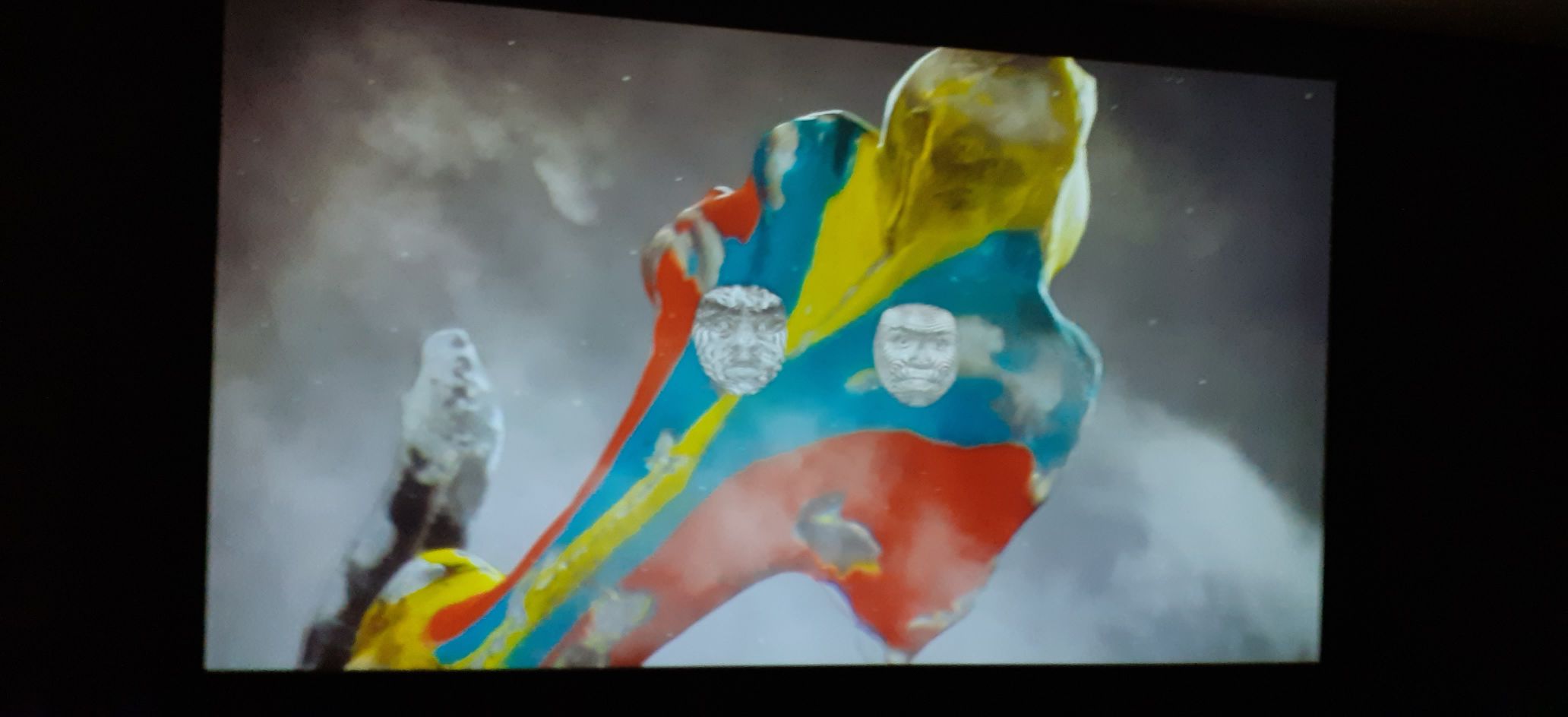
The French-Caribbean artist, Julien Creuzet has made a poignant and profound video that utilises imagery, sound and words to great effect. It is narrated, or rather, sung by a disembodied head(s) that floats dreamlike on the screen like a Greek chorus telling the story of fire, of fog and the spirit of the diaspora. It’s a pertinent theme now.
Julien Creuzet, Ogun, Ogoun
The flower paintings of Precious Okoyomon, bright and with vibrant colours, really grab your attention, as though three-dimensional. The life-like flower heads are comic and sad equally, foreboding in one painting and shocked in another as though someone has creeped up behind them and pinched their bottoms, if they had one. No need for words here as they easily build a narrative just by look alone.
Precious Okoyomon, Zoomorphic angelic beings singing in midnight sugar storms
Though born in Nigeria and resident in London, Ihenua Ellams’ pen picture and written poem next to it smells to me of a very Manchester scene. With the rain, the squashed, depressed heads buried in the pavement either side of a twisting road, the high-rises behind and a bus floating in the air above. You could mistake it for Oxford Road. The poem next to the drawing could be a tale of any city-scape but lines like “The rain clouds will gather” and “Such beautiful sorrow”, speak of the northern Rainy City it’s inhabitants have grown to love/hate.
Ihenua Ellams, Fuck/Concrete
Vivienne Griffin’s digital/graphic film is a dystopian affair fronted by what the video gamer will know as a ‘first person shooter’: a hand pointing a machine gun. We are in a human unoccupied environment populated with large three dimensional words and objects, like candles. Sometimes the scene is devoid of anything as the gunner moves through the landscape, firing balls from the gun with a bad aim. Occasionally a ball hits an object but too far away to effect anything. The machine gun moves closer and a game (of sorts) commences as the shots begin to knock the object over. The whole thing is frustrating and seemingly pointless which may actually be the point, given the piece’s title. A fake environment for a fake culture? I haven’t a clue.
Vivienne Griffin, The Fake Haven
I may be a jaded, cynical atheist but I do believe that ‘spirit’ is something akin to self-consciousness, not a ghost in the sky or some unknowable entity directing our lives. If so, then there may be hope for us yet, though I doubt it.
There is a lot of talk about austerity, about having less austerity, more or even none. For those on the right this is a legitimate activity, but for those on the left who continually use the rhetoric of austerity, that they want less or even no austerity, they are making a serious category error, particularly because they do not question why we have austerity in the first place: capitalism. There are many on the left who only talk of less austerity, it must be assumed that they are not questioning the supreme place that neo-liberal capitalist economy holds in contemporary Western culture. For those on the left who want to see the end of austerity and do not question austerity’s origin in capitalism, it appears that they are misunderstanding austerity.
Capitalism Is The Ideology Not Austerity
A fundamental misunderstanding of austerity is in thinking that it is an ideology. It isn’t the ideology, it is capitalism, and in these times, neo-liberal capitalism that is the ideology. Those on the right and those who are economic libertarians, have capitalist economy as their own particular ideology and (specifically as it rarely affects them) they accept austerity as a positive within this economy that requires its downturns. Capitalist economy accords with their world view, a view that sees no value in the human being in anything other than monetary and as a piece of equipment for use in the workplace.
That certain sections of the left, if not most, collude in this ideology is unfortunate. It is also self-defeating. One aspect of austerity that leads to this misunderstanding is the way austerity is used by those on the right, as evidenced by the 2010-15 government and the current Conservative administration. Austerity is used as a tool by these administrations in order to effect a particular ideology, that of decimating the State’s provisions for its citizens. So, currently, every council in England are making massive cuts to its operational budgets leaving vital services for the disabled, sport and leisure, environment, education and many other unseen provisions, being cut or got rid of completely. Or being privatised which is death by a thousand cuts (pun intended). Nationally we are seeing this happen by the proposed £12billion cuts to welfare and the perilous situation the NHS finds itself in. Witnessing all of this the confused left have concluded that austerity is ideological instead of a tool of ideology. This misunderstanding is further compounded by its rhetorical use by all parties of the left, because in arguing for less austerity or even no austerity they fail to comprehend that they should be arguing for an end to neo-liberal capitalist economy if they want to end austerity. The Chancellor, George Osborne, knows this and is making hay with this knowledge. How? Because no one is seriously disagreeing with him on the need for austerity, only on the minutia, offering sticking plasters thinking this will revive a corpse.
Neo-Liberal Capitalism, Debt And Globalisation
At the time of the latest financial collapse in 2008 the combined debt of advanced capitalist economies went into trillions of dollars. As money is the foundation of all economies, and as debt is the machination used by fiscal economy to fund said economy, it is no surprise that the downturns in capital occur frequently. The severity of the 2008 crash has been exacerbated by three factors: 1. The criminality of the banking sector, particularly in the UK but also generally; 2. The neo-liberal version of capitalism that is in vogue today which requires lax control of the financial markets, a dismantling of government laws and services along with a bigger emphasis on debt as a tool to finance the activities of business and governments. The third, and most pernicious, of the factors that is integral to this latest crash of capital markets is globalisation which is a particularly neo-liberal phenomenon. But the phenomenon of globalisation, as William Greider presciently foretold in One World, Ready Or Not, published in 1997, would swing back at the main players (or those they govern) of globalisation, those who deal in the ‘abstract’ of trading in finance and resources. The logic of globalisation will inevitably lead to reduced living standards of all but the top-tier of society by discarding “old political commitments to social equity and reduce benefit systems for pensions, health care, income support and various forms of ameliorative aid.” (Page, 285) We are clearly in the midst of this scenario now.
Those in the higher echelons of society should feel no comfort by their seeming detachment from the problems the rest of society now faces. By accepting, if not participating in the laissez-faire nature of trading in capital, they have unwittingly set in train the demise of the traditional tools of trade: industrialisation and manufacturing. So there is a trade deficit between exports (the real value of a country’s GDP) and imports (which is usually paid for though debt). Added to this are the mass unemployment caused by jobs moving to cheaper locations and the rise of technology that takes jobs away from humans. As if this was not bad enough the next catastrophe, due to the increasing toll on the planet by burning fossil fuels and by an unsustainable acquisition of resources, is climate change leading to drought, a collapse of vital resources, mass population movements, and, ultimately, unending wars. This ‘perfect storm’ of events will ensure that the elite will become engulfed just like the rest of us, though maybe not as quickly.
The Left Failure To Tackle Capitalism As The Real Cause
The left understands all of this, they have many organisations that deal with each issue above independently. The problem is that taking any issue in society, political or cultural, individually usually means missing the bigger picture. Austerity, as the left have dealt with it, is a case in point. Yes the left would like to see no cuts to vital services, especially for the weak, poor and sick; yes they would like to see no austerity; yes to real employment with good employment rights; yes for the environment to be protected and for an investment in renewable energy technology. The one thing that causes austerity, that causes societal collapse of vital services, that causes environmental degradation, is the capitalist economy. And now, due to the economic orthodoxy of neo-liberalism, contemporary capitalism is refusing to invest in the new manufacturing of renewable energy which could help ameliorate the effects of climate change and unemployment. Capitalism is eating itself and us with it.
None of the left questions the establishment of capital economy, and yet they protest against the effects of this capitalism. Labour said before the 2015 election that they agree with the Tory’s economic plan and when it comes to austerity they would cut only slightly less than the coalition government. The Greens, while being more radical than Labour, do not question the legitimacy of the capitalist economy though they do question the growth principle that is so hard to shake from contemporary economics. Other left groups, like the TUSC and Left Unity, while being specific about having full public ownership of the major utilities, transport infrastructure and vital societal services, fail to mention capitalism and certainly fail to say outright that it is the capitalist economy which is causing all of the problems mentioned above.
Maybe it’s because the left fear how the populace would respond to such a stark message, that it would be electoral suicide. Yet, in Labour’s case, sitting on the same spectrum as the Conservatives, is also electoral suicide. The Tories know this and use it to their advantage knowing that Labour have already agreed with their economic policy. But worse than that is what this acquiescence to the capitalist economy and the subsequent misunderstanding of austerity will lead to. Globalisation is the end game of neo-liberal capitalism and, soon, irrespective of State boundaries, there will be no impediment to the flow of capital and people, all for the benefit of society’s top-tier and their wish to reduce civil society. Added to this is the spectre of the trade deal, TTIP, that will end a government’s right to govern over its own people because it is in complete hock to the Company. Private wealth kills social autonomy. This is the ideology of the right, it should not be an ideology that the left accepts. Can the left find the courage of its convictions to say no to capitalism and, thereby, say no to austerity authentically and with promise? To understand austerity and its fundamental role within capitalism, one has to question capitalism itself.
Sources
One World, Ready Or Not: The Manic Logic Of Global Capitalism, William Greider, Penguin Books, 1997
What must our democracy look like to other people? You know, the others who hold no responsibility for our democracy but yet are affected by our democracy, through wars and the parasitical invasion of their own land, and the emotional, financial and military support of despotic rulers for the control of the resources that belong to the people under such despotic rule – or for that most abused notion: ‘security’.
The other night I watched Irma Vep by French auteur Olivier Assayas starring Maggie Cheung. It is a film about the making of a film. Jean-Pierre Léaud plays a director having a nervous breakdown while remaking a silent French classic Les Vampires, he wants Maggie Cheung to play Irma Vep (Vampire) and she stars in this film as herself.
This is the second time I have seen this film, having first watched it on original release in 1996, and I was interested to note it being described as a satire on ‘intellectual’ French film-making. I cannot recall that I knew that it was a satire when I originally saw it, but then I was a very serious film goer, I had given up mainstream films and was deeply into World Cinema and art-house films. It could be said that I was the intellectual navel-gazing snob that the interviewer in this film claims French cinema tried to attract.
When I got the opportunity to see this film again (on Sky Arts – surprisingly they show films as they are meant to be seen: without adverts) I was interested to see how I appreciated it now as to when I first saw it. Firstly I can see that it is a study of film-making, as I did originally, with most scenes set in the making of the film. Secondly I can see the satire in it that I missed the first time: the critique of the film-making process in France. But, thirdly, the way it is shot, which is very good, I now understand was the element of the film that prevented me from seeing it as a satire first time around: the fluid movements, the narrative structure which is like an essay on film-making, but in the end it is a film taking itself seriously about a film satirising films taking themselves seriously. Seriously! No wonder my young self couldn’t see the satire.
Finally though is Maggie Cheung: my vision of her remains faithful to her original incarnation back in 1996: beautiful, graceful and sublime. It is her presence in the film that questions who or what is really being satirised? She is a vision for the old and discredited auteur Rene Vidal, he sees her in a martial arts movie and wants her for his film on that basis alone: no need to audition, there is no script, he sees in her a natural Irma Vep.
He was right, Cheung is perfectly cast as a cat burglar in a cat suit, no need for words, movements and the pure image suffice. But he breaks down and is replaced by a new director who seems only to care that Irma Vep is played by a Chinese star and not a French star, the affront of it! Ultimately, for me, it is cynicism that is being satirised, the cynical who mock intelligent aspirations, and their cousins the stick-in-the-muds who only respect tradition and reject the visionaries.
Aah…..the pastoral, it conjures up peaceful scenes of harmony, nature all green and pleasant while you daydream away your life in a meadow. Is this image real? Not if you are Martin Crimp, the play-write from Kent who specialises in plays of social decay and moral compromise. And judging by this production by The Lauriston Studio at the Altrincham Garrick Playhouse this is indeed the case: the country isn’t a panacea for the faults of character. This is to the play’s credit I think.
A young couple with their children move to the country. Richard, a doctor, has taken in an unconscious girl from the roadside, we join the action in the night after Richard has deposited the ‘comatose’ woman into the spare bed. His wife, Corinne, is not pleased, and so begins a devilish game of verbal ‘paper, scissors, stone’ where not one of the three characters wins. Richard, played by John McElhatton, seems to have a murky past, his wife, Corinne, while forgiving, is still suspicious about him and his motives, and is extremely concerned as to why, even as a doctor, he has taken in this girl. Immediately we get a hint of the whole picture: an unfaithful past to do with sex and drugs, yet without knowing concretely. Are they escaping from something? When Rebecca, the unconscious girl, is introduced into the story this question becomes three-fold: is he escaping her, is she following him – or is he following her?
The way of the play is claustrophobic, always only two protagonists on stage at any one time: What is going on? On the one hand it seems obvious what is happening: we have ‘city folk’ moving to the country, maybe thinking that it will improve their lives – but what is left unsaid is the exact relationship Richard has with Rebecca, this is slowly teased out but always obliquely. Theatre goers are sophisticated folks after all. What becomes clear is that a change of scenery doesn’t mean a change of character – one cannot escape one’s character by running away, it follows you everywhere. People’s wish of ‘freedom’ has this effect of make believe about it.
The director, Mark Butt, tells us in the program notes that we won’t get any easy answers from this play, and he is right in one sense, but that doesn’t mean that understanding is impossible: yes there are loose ends plot wise and in the character’s destinies, but the play is not about tying up loose ends, I believe, rather it is about a feeling, an aesthetic, almost. We get this feeling with the set: it is the interior of a converted grain barn – it doesn’t look like the country, not like the clichéd image of living in a cottage. With grey colours and a simple table, chair and old-fashioned phone combo, it conjures up alienation and reinforces the feeling that while this couple are now in the country they haven’t escaped their troubles.
The performances are all solid, especially Ali Davenport’s Corinne who we first see cutting out a picture from a magazine, the game of ‘paper, rock, scissors’ between the characters has begun. Ms. Davenport gives the most intense performance, switching between the concerned wife and mother one moment to the distrustful, suspicious (or is that solicitous?) questioner the next. John McElhatton’s Richard was suitably guilty and harassed, annoyed at the bothering’s of his medical partner, Bruce? Boris?, and resentful of his wife’s attentions, while Rebecca, played by Sarah Roberts produced a performance that reminded me of a Mamet character, quick fire questions, repetition of statements: in fact this can be said for all of the characters.
I enjoyed this production and it is perfectly suited to the small, intimate surroundings of The Lauriston Studio.
The Urbis centre in Manchester has a research forum dedicated to the exploration of topics related to the city and urban life. It is a forum that includes talks, discussions, walks and other ‘special events’ on topics like urban planning, the history and culture of the city, and the influence of design practices on the city.
On Monday night I went to the third of the research forums in Urbis entitled Science of the City. In connection with the Manchester Science Festival our speakers were Prof. Trevor Cox (an Acoustic Engineer), Prof. Greg Keeffe(Professor of Sustainable Architecture) and Jon Porter (Technical Director, Countryscape). I missed the first talk by Mr. Porter on the uses of geo-mapping because the tram took longer than I had planned getting into Manchester (Metrolink, maybe that can be another topic one day!).
The next talk was given by Greg Keeffe on Synergetic City: Urban algae production as a regenerative tool for a post-industrial city. Mr. Keeffe specialises in sustainability, energy use and its impact on the design of built form and urban space. He currently holds the prestigious Downing Chair of Sustainable Architecture at the Leeds School of Architecture. This was an interesting talk that incorporated the productive use of nature in both the development of a city landscape and in its self-renewal. The point of Mr. Keeffe’s vision was the development of ‘redundant space’ within the Mersey Estuary using the local natural conditions to create a sustainable environment that will “work synergistically to provide a carbon neutral solution, to the regeneration of the city”. This will be done using algae, making use of the waste products of one synthesis in order to create a new process. He has put his ‘utopian’ vision better himself in his published paper:
“The paper describes the theoretical insertion of a series of glass factories, which produce glass tanks to house algae reactors, that themselves provide the energy to power the glass production. This allows for sustainable infrastructure to be self assembled in an iterative and carbon neutral manner, which once complete, provides more than enough energy to power the new city.
In Free Energy City, the city functions as an energy generator and thrives from its own product with minimal impact upon the planet it inhabits. Alga-culture is the fundamental energy source, where a matrix of algae
reactors swamp the abandoned dockyards; which have been further expanded and reclaimed from the River Mersey. Each year, the algae farm is capable of producing over 200 million gallons of bio-fuel, which in-turn
can produce enough electricity to power almost 2 million homes.”
What I understood from this talk was the integration of at least three things: a renewable industry (glass factories for the production of glass tanks that house algae reactors, these will provide the energy that will power the production of glass), making use of a natural phenomenon (algae) and, thirdly using the synergy provided by the first two aspects to create a sustainable cycle of industry, power and food (cattle can be fed on the waste products of the bio-oil extraction).
What I also understood from this particular talk was the inherent structural problems within the “utopian dream”: there is a sense that the plans for Liverpool that Mr. Keeffe dreams of makes the city rely too much on one particular procedure, all it would take is for one part of the cycle to break down (the collapse of the glass industry or problems with algae due to environmental problems) for the whole viability of the project to be destroyed. Never put all one’s eggs in one basket.
The final talk was given by the acoustic engineer Trevor Cox where he discussed the importance of sounds and smells in the city, how they can annoy, how they can create an improved environment, but essentially how all city planning should incorporate the design skills developed in acoustic engineering: for example the way buildings are positioned in relation to the rest of the local environment can lessen the noise from adjacent streets.
One thing that came to me while listening to the speakers, especially Mr. Keeffe, was a general observation about the different attitudes between the Classical style of architecture, typified by the Doric, with its large stone columns and domineering crowding of the natural world, and the contemporary style which trys to incorporate nature in its design by the use of materials that leaves a softer impression on the landscape, yet both are monumental.
The Q & A session was trundling along when it was livened up by a questioner who took affront with the lack of historical perspective that he felt was given, by Mr. Keeffe in particular, towards the use of statistics and the ‘development’ of human societies, alluding to the Nazi’s use of statistics to support their theories of eugenics. This is my interpretation of the questioner’s point, I may be wrong, but it brought to mind a more general point that I proceeded to make: that there was something totalitarian about technology, about the way that it can restrict behaviour as well as extend it. Streets are planned which say ‘this is the way’, new technologies come about (usually by accident) that delineate the access to its treasures: the internet is a contemporary example that will increasingly be more and more necessary to complete everyday tasks that we do in person today (banking, access to social services, ect). Fundamentally though, I am at the conclusion that it is wise to be sceptical of the idea of ‘progress’: utopian dreams often end in nightmares.
All in all the Urbis Research Forum project is very worthwhile, these are topics that need to be debated by us all if we wish to live in a tolerable environment, but I have reservations about Urbis holding these talks as the organiser of this event told me afterwards that he was annoyed about one questioner “hijacking” the event. This was untrue, but also, the event is defined as a public forum. Oh well, its typical of the management class to ignore their own rules.
I was going to write about two contemporary exhibitions I had been to recently, The Social Lives of Objects and POI: Moving, Mapping, Memory from Castlefield Gallery and Cornerhouse respectively, I had made some notes and was ready to start writing, but I couldn’t do any: why? I was completely uninspired and underwhelmed by the two shows I had seen. This conclusion was initially hidden from me because I was caught up in the two exhibition’s theorising, walking around the shows with a mind full of the intentions of the artists, and worse, the expectations of the curators. My aesthetic values are clearly different from the artists on show because I found no beauty in these exhibitions, I found the experiences akin more to an educational seminar than an aesthetic experience, one shouldn’t have to think too much in order to appreciate, never mind enjoy, a piece of art. It seems that today’s art privileges theory over artistic craftsmanship.Yes, I am criticising the ‘artistic skills’ of these artists: one of the exhibitions resembled a car boot sale with random objects dotted about the place as though your grandparent’s house had been ransacked, indeed one of the exhibits consisted of an old Penguin book with the last page reconstructed from itself – trash. The other show was too earnest, trying to make the usual liberal political points, and for the second exhibition in a row the top floor gallery was given over (partially) to a animal den. Much of contemporary art is conceptual art now, the boundaries between the two are no more, and I’m sure its because of our modern sensibilities. As times pass humanity gets heavier with explanation, it occupies us more and our culture will reflect this fact.
And yet, for me, I find that the more I explain, look into, theorise, try to understand visual art, the further I find I am from the aesthetic experience. This, of course, was the first lesson I learnt in the Philosophical Aesthetics class I took when at university. There is always this tension between the theory and the art that comes from it, but a gallery should never make you feel like you are in a classroom.
Sometimes I come away from ‘contemporary exhibitions’ asking myself ‘was that art?’, ‘what is art, anyway?’, and so on, often to escape the empty response generated by the exhibition just viewed, but here these questions, and a few more, are central to this exhibition by Manuel Saiz. It makes for a strange experience, of repetitive suggestions brought on by various short film installations, a plaque and a flow chart. Questions, suggestions, this is an exhibition of first principals, it asks a question of art itself.
What is art? The piece What is Art Flowchart is literal being what it says it is, and by asking the question it demands a response. What is art? that’s easy to know, isn’t it? Naturally, though, there are many answers, almost as many as there are people who would answer the question. We are confronted with one question, three possible answers and many different consequences to your own definition of art depending on the choices you make. So what is art? Objects? People? or maybe circumstances? Already I’m not happy: why am I restricted? couldn’t ‘art’ be whatever ‘the artist’ says it is? Find me someone self-declared as an artist, let them point to art, then all we have to do is ask ourselves: is this art any good? But that’s not a question of first principals, it asks a value judgement. It is much more difficult to be forced to decide not only what art is but who the artist is too.
What Is Art?
Who is the artist? A self-declared one, as Joseph Beuys may or may not have said. Anyone can be an artist, and I have no problem with such a proposition, but there are some institutions that do care who the artist is, who do want to demarcate the lines between those inside art and those outside it, self-perpetuating institutions who suffocate………..our fundamental needs? Maybe we can accept that everyone has a potential to be an artist, that its part of the human condition, a fundamental need, but who opens the door and lets the artist in? In a way the title of this exhibition prompts that last question, pointing to those self-perpetuating institutions that define ‘art’ for us, telling us to ‘come in’ or to ‘go away’. As the exhibition brochure says in relation to the piece Pride: “The phrase on the plaque (Manuel Saiz proudly supports Galeria Moriarty) refers to an economic relationship and social structure encouraging us to reflect upon the context in which contemporary art is produced and consumed.”
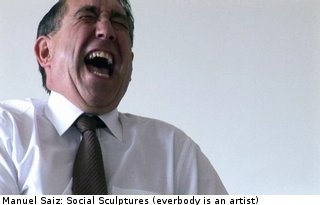
There are aesthetic moments too. The video installations Social Sculptures (everybody is an artist) and The Two Teams Team are contrived enough for the viewer to see that an artist’s hand has been at work. Indeed with Social Sculptures we get from the three actors involved something akin to performance art, and that because of the repetitive nature of the video we enter into surreal moments that are quite funny: absurd moments brought on by the nonsensical repetitions of various statements: ‘everybody is an artist’; ‘anyone can be an artist’; ‘no one is an artist’; and so on, accompanied by happy/sad, fearful/angry, emotions. Repeating anything over and over, either visual or literal, muddies the comprehensible waters, but it also brings in the thought that memory is essential for knowledge, to know what you are doing means that you remember. Related is the ancient Greek word mimesis, which means ‘to represent’, one copies, and one remembers in order to copy: if anyone can be an artist then they must remember to be one.
Surely the ‘aesthetic moments’ are aroused by their contrived and conceited nature? All ‘real’ and ‘authentic’ art must be artificial, it must be seen as obviously planned that is how one enjoys the ‘craft’ of the artist. Trickery is involved, no doubt, a certain trompe l’oeil, which becomes evident in the piece The Two Teams Team, a short film where two actors take a break on set and discuss the merits of video art and the movies. Are these unguarded moments we are witnessing? The film begins and ends with the director saying ‘cut’ and the scene opening to reveal a working set. We are left questioning ‘truth and reality’, but any astute observer will understand the artificial hand of the artist, Manuel Saiz, subtly directing the film revealing the onion-like layers of meaning and interpretation, all very considered. And that’s it: this ‘made-up’ element is essential to defining what art is.
I come away from this exhibition in a conceptual loop, brought on from the video installations (videos shown in a loop for the casual visitor) and the questions revolving around my head. But I have come away with some ‘certainties’ reinforced: that art is a fundamental need, that art has to be made and that an artist must declare themselves. I believe Manuel Saiz is an artist and that he shows art, so, is it any good? Its OK, and that’s my private view, you may disagree.





 Kevin Nebula