Strength, Power and the Mind

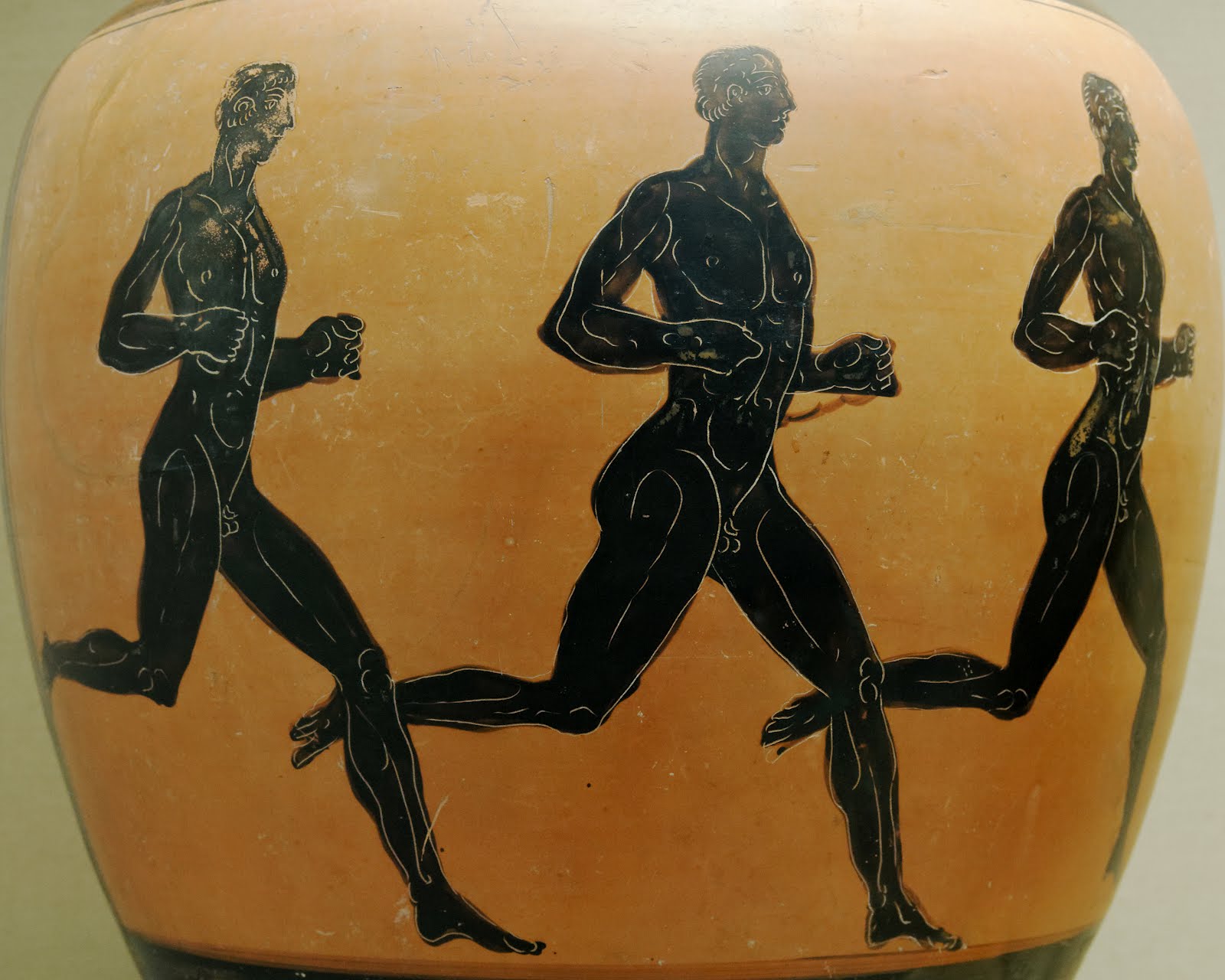
Panathenaic prize amphora showing three runners. Athens, 333-332 BC

We know today’s analogy: Obsession with the body results in a small mind (and other things!). Based on this assumption it explains the phenomenon of “stupid sports people”. It is also a bastardisation of the original ideal at the origin of Western civilisation: healthy body and mind: the ancient Greeks believed passionately about this and many of their first philosophers were fit and active in body as well as in mind. But this process didn’t arrive at once, the faculties of the mind and body have to be nurtured and developed, body first, as that supports the brain, then, with sufficient physical development, the mind. Many of the ancient philosophers lived to old age, which, considering the times they were in and the equivalent state of technology they had, was a great testament to their ‘healthy body and mind’ lifestyles. Of course, the philosophy we know of theirs today was mostly recorded in their older years, and this is due to the natural progression of life, not by premeditation on their behalf.

Of course, not all sports people are stupid, that would be ridiculous, but is it the case that all politicians at the higher echelons of power are stupid? Let’s face it, the real reason for a state’s success or failure depends on the amount of power it has through its ‘physical’ attributes: this ability to ‘take things’ (or give things) is economic too. So it seems that the closer you get to this kind of power the more stupid you become – in a way similar to how difficult it is to think clearly while recovering from a vigorous bout of exercise, (well that’s my experience), today’s ‘leaders’ are increasingly showing this mental exhaustion as power approaches. I’m sure it’s always been the case in political (and business) circles – it was just easier to hide the delusion of competence back then.

My Visions of Irma Vep

Maggie Cheung as Irma Vep

The other night I watched Irma Vep by French auteur Olivier Assayas starring Maggie Cheung. It is a film about the making of a film. Jean-Pierre Léaud plays a director having a nervous breakdown while remaking a silent French classic Les Vampires, he wants Maggie Cheung to play Irma Vep (Vampire) and she stars in this film as herself.

This is the second time I have seen this film, having first watched it on original release in 1996, and I was interested to note it being described as a satire on ‘intellectual’ French film-making. I cannot recall that I knew that it was a satire when I originally saw it, but then I was a very serious film goer, I had given up mainstream films and was deeply into World Cinema and art-house films. It could be said that I was the intellectual navel-gazing snob that the interviewer in this film claims French cinema tried to attract.

When I got the opportunity to see this film again (on Sky Arts – surprisingly they show films as they are meant to be seen: without adverts) I was interested to see how I appreciated it now as to when I first saw it. Firstly I can see that it is a study of film-making, as I did originally, with most scenes set in the making of the film. Secondly I can see the satire in it that I missed the first time: the critique of the film-making process in France. But, thirdly, the way it is shot, which is very good, I now understand was the element of the film that prevented me from seeing it as a satire first time around: the fluid movements, the narrative structure which is like an essay on film-making, but in the end it is a film taking itself seriously about a film satirising films taking themselves seriously. Seriously! No wonder my young self couldn’t see the satire.

Finally though is Maggie Cheung: my vision of her remains faithful to her original incarnation back in 1996: beautiful, graceful and sublime. It is her presence in the film that questions who or what is really being satirised? She is a vision for the old and discredited auteur Rene Vidal, he sees her in a martial arts movie and wants her for his film on that basis alone: no need to audition, there is no script, he sees in her a natural Irma Vep.

He was right, Cheung is perfectly cast as a cat burglar in a cat suit, no need for words, movements and the pure image suffice. But he breaks down and is replaced by a new director who seems only to care that Irma Vep is played by a Chinese star and not a French star, the affront of it! Ultimately, for me, it is cynicism that is being satirised, the cynical who mock intelligent aspirations, and their cousins the stick-in-the-muds who only respect tradition and reject the visionaries.

The Country by Martin Crimp at The Lauriston Studio

Aah…..the pastoral, it conjures up peaceful scenes of harmony, nature all green and pleasant while you daydream away your life in a meadow. Is this image real? Not if you are Martin Crimp, the play-write from Kent who specialises in plays of social decay and moral compromise. And judging by this production by The Lauriston Studio at the Altrincham Garrick Playhouse this is indeed the case: the country isn’t a panacea for the faults of character. This is to the play’s credit I think.

A young couple with their children move to the country. Richard, a doctor, has taken in an unconscious girl from the roadside, we join the action in the night after Richard has deposited the ‘comatose’ woman into the spare bed. His wife, Corinne, is not pleased, and so begins a devilish game of verbal ‘paper, scissors, stone’ where not one of the three characters wins. Richard, played by John McElhatton, seems to have a murky past, his wife, Corinne, while forgiving, is still suspicious about him and his motives, and is extremely concerned as to why, even as a doctor, he has taken in this girl. Immediately we get a hint of the whole picture: an unfaithful past to do with sex and drugs, yet without knowing concretely. Are they escaping from something? When Rebecca, the unconscious girl, is introduced into the story this question becomes three-fold: is he escaping her, is she following him – or is he following her?

The way of the play is claustrophobic, always only two protagonists on stage at any one time: What is going on? On the one hand it seems obvious what is happening: we have ‘city folk’ moving to the country, maybe thinking that it will improve their lives – but what is left unsaid is the exact relationship Richard has with Rebecca, this is slowly teased out but always obliquely. Theatre goers are sophisticated folks after all. What becomes clear is that a change of scenery doesn’t mean a change of character – one cannot escape one’s character by running away, it follows you everywhere. People’s wish of ‘freedom’ has this effect of make believe about it.

The director, Mark Butt, tells us in the program notes that we won’t get any easy answers from this play, and he is right in one sense, but that doesn’t mean that understanding is impossible: yes there are loose ends plot wise and in the character’s destinies, but the play is not about tying up loose ends, I believe, rather it is about a feeling, an aesthetic, almost. We get this feeling with the set: it is the interior of a converted grain barn – it doesn’t look like the country, not like the clichéd image of living in a cottage. With grey colours and a simple table, chair and old-fashioned phone combo, it conjures up alienation and reinforces the feeling that while this couple are now in the country they haven’t escaped their troubles.

The performances are all solid, especially Ali Davenport’s Corinne who we first see cutting out a picture from a magazine, the game of ‘paper, rock, scissors’ between the characters has begun. Ms. Davenport gives the most intense performance, switching between the concerned wife and mother one moment to the distrustful, suspicious (or is that solicitous?) questioner the next. John McElhatton’s Richard was suitably guilty and harassed, annoyed at the bothering’s of his medical partner, Bruce? Boris?, and resentful of his wife’s attentions, while Rebecca, played by Sarah Roberts produced a performance that reminded me of a Mamet character, quick fire questions, repetition of statements: in fact this can be said for all of the characters.

I enjoyed this production and it is perfectly suited to the small, intimate surroundings of The Lauriston Studio.

Urbis Research Forum: Science of the City

The Urbis centre in Manchester has a research forum dedicated to the exploration of topics related to the city and urban life. It is a forum that includes talks, discussions, walks and other ‘special events’ on topics like urban planning, the history and culture of the city, and the influence of design practices on the city.

On Monday night I went to the third of the research forums in Urbis entitled Science of the City. In connection with the Manchester Science Festival our speakers were Prof. Trevor Cox (an Acoustic Engineer), Prof. Greg Keeffe(Professor of Sustainable Architecture) and Jon Porter (Technical Director, Countryscape). I missed the first talk by Mr. Porter on the uses of geo-mapping because the tram took longer than I had planned getting into Manchester (Metrolink, maybe that can be another topic one day!).

The next talk was given by Greg Keeffe on Synergetic City: Urban algae production as a regenerative tool for a post-industrial city. Mr. Keeffe specialises in sustainability, energy use and its impact on the design of built form and urban space. He currently holds the prestigious Downing Chair of Sustainable Architecture at the Leeds School of Architecture. This was an interesting talk that incorporated the productive use of nature in both the development of a city landscape and in its self-renewal. The point of Mr. Keeffe’s vision was the development of ‘redundant space’ within the Mersey Estuary using the local natural conditions to create a sustainable environment that will “work synergistically to provide a carbon neutral solution, to the regeneration of the city”. This will be done using algae, making use of the waste products of one synthesis in order to create a new process. He has put his ‘utopian’ vision better himself in his published paper:

“The paper describes the theoretical insertion of a series of glass factories, which produce glass tanks to house algae reactors, that themselves provide the energy to power the glass production. This allows for sustainable infrastructure to be self assembled in an iterative and carbon neutral manner, which once complete, provides more than enough energy to power the new city.

In Free Energy City, the city functions as an energy generator and thrives from its own product with minimal impact upon the planet it inhabits. Alga-culture is the fundamental energy source, where a matrix of algae
reactors swamp the abandoned dockyards; which have been further expanded and reclaimed from the River Mersey. Each year, the algae farm is capable of producing over 200 million gallons of bio-fuel, which in-turn
can produce enough electricity to power almost 2 million homes.”

What I understood from this talk was the integration of at least three things: a renewable industry (glass factories for the production of glass tanks that house algae reactors, these will provide the energy that will power the production of glass), making use of a natural phenomenon (algae) and, thirdly using the synergy provided by the first two aspects to create a sustainable cycle of industry, power and food (cattle can be fed on the waste products of the bio-oil extraction).

What I also understood from this particular talk was the inherent structural problems within the “utopian dream”: there is a sense that the plans for Liverpool that Mr. Keeffe dreams of makes the city rely too much on one particular procedure, all it would take is for one part of the cycle to break down (the collapse of the glass industry or problems with algae due to environmental problems) for the whole viability of the project to be destroyed. Never put all one’s eggs in one basket.

The final talk was given by the acoustic engineer Trevor Cox where he discussed the importance of sounds and smells in the city, how they can annoy, how they can create an improved environment, but essentially how all city planning should incorporate the design skills developed in acoustic engineering: for example the way buildings are positioned in relation to the rest of the local environment can lessen the noise from adjacent streets.

One thing that came to me while listening to the speakers, especially Mr. Keeffe, was a general observation about the different attitudes between the Classical style of architecture, typified by the Doric, with its large stone columns and domineering crowding of the natural world, and the contemporary style which trys to incorporate nature in its design by the use of materials that leaves a softer impression on the landscape, yet both are monumental.

The Q & A session was trundling along when it was livened up by a questioner who took affront with the lack of historical perspective that he felt was given, by Mr. Keeffe in particular, towards the use of statistics and the ‘development’ of human societies, alluding to the Nazi’s use of statistics to support their theories of eugenics. This is my interpretation of the questioner’s point, I may be wrong, but it brought to mind a more general point that I proceeded to make: that there was something totalitarian about technology, about the way that it can restrict behaviour as well as extend it. Streets are planned which say ‘this is the way’, new technologies come about (usually by accident) that delineate the access to its treasures: the internet is a contemporary example that will increasingly be more and more necessary to complete everyday tasks that we do in person today (banking, access to social services, ect). Fundamentally though, I am at the conclusion that it is wise to be sceptical of the idea of ‘progress’: utopian dreams often end in nightmares. 

All in all the Urbis Research Forum project is very worthwhile, these are topics that need to be debated by us all if we wish to live in a tolerable environment, but I have reservations about Urbis holding these talks as the organiser of this event told me afterwards that he was annoyed about one questioner “hijacking” the event. This was untrue, but also, the event is defined as a public forum. Oh well, its typical of the management class to ignore their own rules.

Too Much Theory Not Enough Art

Too much art theory?
I was going to write about two contemporary exhibitions I had been to recently, The Social Lives of Objects and POI: Moving, Mapping, Memory from Castlefield Gallery and Cornerhouse respectively, I had made some notes and was ready to start writing, but I couldn’t do any: why? I was completely uninspired and underwhelmed by the two shows I had seen. This conclusion was initially hidden from me because I was caught up in the two exhibition’s theorising, walking around the shows with a mind full of the intentions of the artists, and worse, the expectations of the curators. My aesthetic values are clearly different from the artists on show because I found no beauty in these exhibitions, I found the experiences akin more to an educational seminar than an aesthetic experience, one shouldn’t have to think too much in order to appreciate, never mind enjoy, a piece of art. It seems that today’s art privileges theory over artistic craftsmanship.Yes, I am criticising the ‘artistic skills’ of these artists: one of the exhibitions resembled a car boot sale with random objects dotted about the place as though your grandparent’s house had been ransacked, indeed one of the exhibits consisted of an old Penguin book with the last page reconstructed from itself – trash. The other show was too earnest, trying to make the usual liberal political points, and for the second exhibition in a row the top floor gallery was given over (partially) to a animal den. Much of contemporary art is conceptual art now, the boundaries between the two are no more, and I’m sure its because of our modern sensibilities. As times pass humanity gets heavier with explanation, it occupies us more and our culture will reflect this fact.

And yet, for me, I find that the more I explain, look into, theorise, try to understand visual art, the further I find I am from the aesthetic experience. This, of course, was the first lesson I learnt in the Philosophical Aesthetics class I took when at university. There is always this tension between the theory and the art that comes from it, but a gallery should never make you feel like you are in a classroom.

Manuel Saiz: Private Party. Keep Out.

Manuel Saiz: Private Party. Keep Out
Castlefield Gallery
06 February 2009 to 22 March 2009
Wednesday – Sunday 1 – 6 pm

Sometimes I come away from ‘contemporary exhibitions’ asking myself ‘was that art?’, ‘what is art, anyway?’, and so on, often to escape the empty response generated by the exhibition just viewed, but here these questions, and a few more, are central to this exhibition by Manuel Saiz. It makes for a strange experience, of repetitive suggestions brought on by various short film installations, a plaque and a flow chart. Questions, suggestions, this is an exhibition of first principals, it asks a question of art itself.

What is art? The piece What is Art Flowchart is literal being what it says it is, and by asking the question it demands a response. What is art? that’s easy to know, isn’t it? Naturally, though, there are many answers, almost as many as there are people who would answer the question. We are confronted with one question, three possible answers and many different consequences to your own definition of art depending on the choices you make. So what is art? Objects? People? or maybe circumstances? Already I’m not happy: why am I restricted? couldn’t ‘art’ be whatever ‘the artist’ says it is? Find me someone self-declared as an artist, let them point to art, then all we have to do is ask ourselves: is this art any good? But that’s not a question of first principals, it asks a value judgement. It is much more difficult to be forced to decide not only what art is but who the artist is too.

What Is Art?
What Is Art?

Who is the artist? A self-declared one, as Joseph Beuys may or may not have said. Anyone can be an artist, and I have no problem with such a proposition, but there are some institutions that do care who the artist is, who do want to demarcate the lines between those inside art and those outside it, self-perpetuating institutions who suffocate………..our fundamental needs? Maybe we can accept that everyone has a potential to be an artist, that its part of the human condition, a fundamental need, but who opens the door and lets the artist in? In a way the title of this exhibition prompts that last question, pointing to those self-perpetuating institutions that define ‘art’ for us, telling us to ‘come in’ or to ‘go away’. As the exhibition brochure says in relation to the piece Pride: “The phrase on the plaque (Manuel Saiz proudly supports Galeria Moriarty) refers to an economic relationship and social structure encouraging us to reflect upon the context in which contemporary art is produced and consumed.”

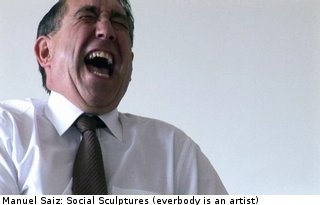
There are aesthetic moments too. The video installations Social Sculptures (everybody is an artist) and The Two Teams Team are contrived enough for the viewer to see that an artist’s hand has been at work. Indeed with Social Sculptures we get from the three actors involved something akin to performance art, and that because of the repetitive nature of the video we enter into surreal moments that are quite funny: absurd moments brought on by the nonsensical repetitions of various statements: ‘everybody is an artist’; ‘anyone can be an artist’; ‘no one is an artist’; and so on, accompanied by happy/sad, fearful/angry, emotions. Repeating anything over and over, either visual or literal, muddies the comprehensible waters, but it also brings in the thought that memory is essential for knowledge, to know what you are doing means that you remember. Related is the ancient Greek word mimesis, which means ‘to represent’, one copies, and one remembers in order to copy: if anyone can be an artist then they must remember to be one.

Surely the ‘aesthetic moments’ are aroused by their contrived and conceited nature? All ‘real’ and ‘authentic’ art must be artificial, it must be seen as obviously planned that is how one enjoys the ‘craft’ of the artist. Trickery is involved, no doubt, a certain trompe l’oeil, which becomes evident in the piece The Two Teams Team, a short film where two actors take a break on set and discuss the merits of video art and the movies. Are these unguarded moments we are witnessing? The film begins and ends with the director saying ‘cut’ and the scene opening to reveal a working set. We are left questioning ‘truth and reality’, but any astute observer will understand the artificial hand of the artist, Manuel Saiz, subtly directing the film revealing the onion-like layers of meaning and interpretation, all very considered. And that’s it: this ‘made-up’ element is essential to defining what art is.

I come away from this exhibition in a conceptual loop, brought on from the video installations (videos shown in a loop for the casual visitor) and the questions revolving around my head. But I have come away with some ‘certainties’ reinforced: that art is a fundamental need, that art has to be made and that an artist must declare themselves. I believe Manuel Saiz is an artist and that he shows art, so, is it any good? Its OK, and that’s my private view, you may disagree.

Rachel Goodyear – They never run, only call

Rachel Goodyear – They never run, only call
24th January – 7th March 2009
Wednesday – Saturday 12pm – 5pm
The International 3
This is the second exhibition Rachel Goodyear has given in Manchester in as many months, the last one at the Cornerhouse with The Intertwining Line, where she exhibited with other artists. I meant to blog on it but never got round to it (naughty me!) Anyway, I became interested in Goodyear’s work there and decided to pop along to The International 3 to see her latest work.

Goodyear draws, in graphite and ink, small intimate pictures of people and animals, and the natural world usually entwined in ambiguous moments, that was the impression I had going to this exhibition, and my imagination wasn’t disappointed. On leaving I did a word association game in my mind to try and distil some of what I had just seen. I came up with ‘isolation’, ‘void’, ‘unprotected’, ‘suggestive’, ‘technical’, ‘mythology’, ‘miniature’, and ‘sightless’, among other words, and these words, or the impression they give, sums up Goodyear’s recent work for me.

I attended a talk that Goodyear gave at the Cornerhouse to accompany her art in The Intertwining Line so I already knew that she was interested in concepts like the void and isolation. But I think that any viewer of her work can come to this conclusion, I get it initially from the medium her work is presented in: white paper with minimal pencil or pen drawings. We get pictures of dogs, people, birds and wolfs, alone or in groups, branches reaching out, insects invading, and it becomes clear to me that they cannot be ‘isolated’, that there is always something going on, an interaction of some sort, no the feeling that is inspired is vacuum, or maybe ennui and a sense of aloneness, extenuating the space between, as no phenomenon is in isolation. I am making a philosophical point here, ‘isolation’ is a word misused in much the same way that ‘nothingness’ is misused, as, strictly being, there is no such thing as ‘isolation’ or ‘nothingness’, there always being something. It is impossible to represent ‘isolation’ one can only approximate something similar to it, say, a vacuum: that is: ‘a region containing no matter, free space’. Scientists can measure vacuums because they can be compared with what is around them (a region), ‘isolation’ on its literal meaning (‘without regards to context, similar matters’), cannot be measured and, therefore, cannot be known.

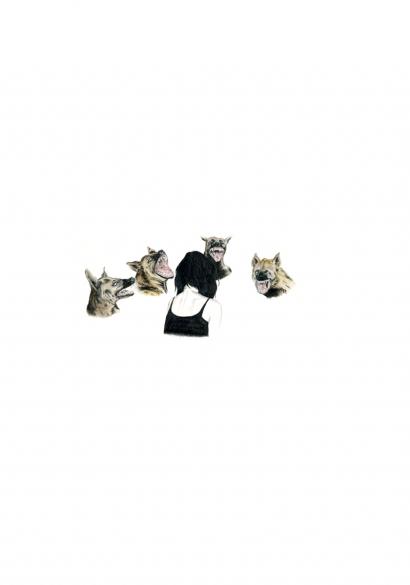
I digress, it is a bit of a bug-bear with me as I have a phenomenological theory that ‘no phenomenon is in isolation’ because no thing has ever come from nothing…………(I’ll leave that for another post); but what these thoughts bring to my impression of Goodyear’s art do tally with something she has said about her work, the unprotected nature of what she does and what she represents: “Drawing manifests itself upon paper or the manipulation of found objects, all displayed unprotected, offering no evident elevation of status from conception to display.” (from this website) We get this unprotected narrative, look at Girl who smiles at dogs, 2008, four dogs in a semi-circle (Alsations?) facing us snarling, teeth showing. There is a woman’s back, shoulders and head facing us, we must assume her condition, fear? terror? or something malevolent, “a look of ghastly, twisted satisfaction on her face.” as the exhibition leaflet says. That’s the point, its unprotected, and to a degree, sightless: when the eyes are not facing us, they are either physically missing, altered in some way or misplaced as in Making new acquaintances, 2009. This art is very suggestive, presented on the walls with no accompanying titles (though they are all titled) they can be viewed with your own fantasies in mind. The titles, when you come to them, are straight-forward, descriptive titles that leave no room to dream…….Stags with dark eyes……Girl through a hoop……….Dog digging…….yet every single image leaves questions (unprotected?), why is she doing that? what does it mean? why are they interacting like that? There is no obvious narrative.

Or maybe the narrative is fantastical and mythological? On the face of it, of course we’re in some sort of fantasy when we view these pictures, they’re so unreal, everyday objects (people, animals, trees, ect) taken out of an everyday context, with interactions between man and animal, incongruent relations…….ah, now we’re in the realm of myths. Traditional definitions tell me that a myth contains super-human beings, determined in an earlier age, a pre-literate age, that natural phenomenons are interpreted by such fantastical creatures. or that the myth is a theme or character-type that represents an idea. Goodyear’s myths should be treated as similes, that is the drawings, like a figure of speech, resembling one thing in order to represent something other, of a different category. We get a sense of this in the graphite scene, Cave that Coughed, where out of the white void comes a cave entrance spitting out some twisted branch on which resides a wolf, snakes, some birds, one of which is falling off. The exhibition curator, Angela Kingston, in her explanatory notes, refers to Jung’s interpretation of a dream he had about a cave: “Jung interpreted the cave in his dream as a passage to the unconscious.” She should know that this ‘interpretation’ was actually Jung’s interpretation/use of Plato’s Cave Analogy, inverted: while Plato wished to show the ‘real world’ to the cave dwellers by leading them from the cave and into the light of the sun, explaining that to begin with the brightness of the sun (true knowledge, which comes from the Forms) would make it hard to see, Jung was interested in the psychological aspects of the dark, the unconscious. Truth is to be found in the recesses, of the mind as well as in nature. (Another bug-bear of mine is that, philosophically and phenomenologically speaking, there is no such thing as the ‘unconscious’, what is meant by this word is ‘repressed memory’, it being impossible to ‘unconsciously recognise the unconscious’, no we forget conscious moments.) Goodyear provides another interpretation bringing in the thought of co-existence and evolution: how do these animals live (and evolve) together in a cave, this wolf, snake and birds?

And this is what I like from art, the posing, the disputes over meaning, but there is also beauty involved, a technical element that pleases. These are delicately drawn illustrations that show technical virtuosity, with a naturalist’s eye for detail. Close up viewing is required and this takes me back to the minimal presentation of these drawings, their focused nature: the surrounding void focusses the eye. I am also reminded of Goya’s engravings, individual moments of madness frozen in time, the sense of abuse, the implied torment that some of Goodyear’s characters go through, we see women in unnatural positions, with physical abnormalities, alien-like growths………where do we go from here? To the art gallery, I say.
Holman Hunt and the Pre-Raphaelite Vision

Holman Hunt and the Pre-Raphaelite Vision
Saturday 11 October 2008 – Sunday 11 January 2009
Manchester Art Gallery

I should like this stuff, it’s medium is oil on canvas (for the most part), with a healthy splattering of colour and they even try to explore a narrative, yet Pre-Raphaelite paintings leave me cold. As a contemporary comparison, Impressionist paintings do not leave me cold and it is their lack of morality and their profound interest in representing nature truthfully (and aesthetically) that warms me every time I view them.

So, what is it about the Pre-Raphaelite’s that I’m sceptical about? A quote from Holman Hunt himself goes some way to explaining my troubles with the Pre-Raphaelite movement:

“Painters should go out….like merchants of nature, and bring home precious merchandise in faithful pictures….with something like the spirit of Apostles, fearing nothing, going amongst robbers and in deserts with impunity as men without anything to lose.”

Nothing in life is disinterested and having spiritual impulses should not necessaryly detract from a work of art, but this quote shouldn’t hide the propaganda behind such images, and nor should such “merchants of nature” be considered as representing nature truthfully, they do not, they represent a cultural imposition: not the method, just the message.

For Holman Hunt and the Pre-Raphaelites, nature is sick – you see this in the paintings on display in this exhibition, the representation of torment that can only be relieved by the Christian promise – the colours of life are garish, there is an imbalance somewhere. This ‘sickness’ we see in The Scapegoat with its other-worldly dusk and wobbly, symbolic goat. This symbolism and ‘other-worldliness’ reaches a disturbing conclusion with The Triumph of the Innocents, this image of children fleeing Herod’s infanticide with Mary, Joseph and Jesus is disturbing, not because of the subject matter, but rather because of the picture itself: frankly the infants look demonic and this is probably an insight into the perverse relationship the British have with children. These demonic ‘cherubs’ are far removed from Botticelli’s puttos, they don’t seem to belong in the scene that is painted. While the rounded infants found in Botticelli’s work can provoke they are also evanescent, captured with delicacy.

Tom Lubbock in the Independent expressed what I felt walking through this exhibition:

“He oppresses on three fronts. Symbolism. Moralism. Materiality. In a Hunt painting, every detail signifies something. It preaches a lesson. And most oppressively it has a solid, glistening physical presence.”

His work is too ‘heavy’, especially the palette with its bold, contrasting colours. Above I said that Pre-Raphaelite paintings leave me cold while Impressionist paintings don’t. Yes Monet’s palette contains bold, contrasting colours, but he used them in a much less incongruent way, leaving a more natural impression. With Hunt (and the other Pre-Raphaelite painters) there is, I think, an unintended dissonance between their depiction of nature and their ‘moral message’ super-imposed over the paintings – unintended to the modern viewer, at least. No doubt their way of representing nature ‘truthfully’ came at the insistent call of their Christian philosophy.

All in all, I won’t deny that these paintings hold interest but they are not profound, they are too circumstantial for that, historical paintings with too much baggage that instigates their origin.

The Comedian


The joke is the comedian: don’t develop the joke develop yourself.