To be a nihilist who wants to give value to the world.
2
The philosopher must become a child
3
The ‘blonde beast’ is actually the lion tearing away history so the child can play.
4
You are finite but your potential is infinite. This is our fate.
5
An infinite becoming is yours, ‘What was scattered gathers. What was gathered blows apart.’ Everything you do, now that the lion has finished, can be a new becoming.
1 The concept of happiness causes more unhappiness than it’s teleological aim.
2 To physically exert oneself is, primarily, an emotional experience. The body is our truth.
3 Once you love your fate you can control your own will to power and become a free spirit in the eternal recurrence of the same. Be history, become your authentic history.
4 Love your fate, reject determinism and say Yes to life.
5 Freedom is the acceptance of fate. Determinism, as defined in the scientific method, is not freedom.
6 Science treats the body abstractly, in isolation, as though the body is a doorstep and not the higher power that it actually is.
7 Laud the potent individual, look away from the leveling down of culture (the state is an example of this) to suit the masses.
8 The above is an attempt to transcend nihilism. We (individually) are more than the calculated parts of our body and environment.
A walk, a bridge over a motorway, jammed with cars, people hanging out of their window haranguing each other under the merciless sun. The explorer walks into a wooded area, another bridge over empty wasteland. Halfway across this bridge is a modern steel building adorned with a huge, garish Union Jack. A small outer building (more a wooded shed) is to the right of the larger building as the explorer sees it from the bridge. Two monks appear in rough brown robes walking towards the explorer calling out, “Do you like it?”, over and over again. The explorer gets nervous and retreats the way he came.
Another day with the explorer and he’s back on the third bridge, the two monks appear again, this time silent. A youth passes the explorer and steps off the bridge meeting the first monk who’s advancing towards him. The second monk is nowhere to be seen. The explorer hesitantly follows the monk and the youth some way behind. There is a missing step, or maybe its a hole, at the end of this bridge as though its a test of commitment and bravery.
The explorer is brave, he steps off the last bridge and hurries towards the youth and the monk. He is greeted but the explorer only recognises this through his mind alone. They walk and there is a large space that they either walk into or it opens up before their eyes, no one can be sure. They are on a platform, below them and growing beyond them is a vast circular expanse outlined with large desktops. The explorer can see people at the desks, not well defined but with loud colours not one the same. It looks like the colourful people are working on something but its hard to see what exactly. Nothing is well defined apart from the colours. There seems a shadow of objects on the desks, machine or other cannot be told. Suddenly out of the silence comes a heavy beat and a deep base noise. The beat is regular and it penetrates the explorer’s chest, the youth seems to be dancing.
A large carousel slides silently into view. The remaining monk motions us to the platform so we can take a seat. The youth jumps on, the explorer hesitates then with a nod, climbs into the chariot. It is noticeable that the beat and base slow and it is also noticeable that its origin is not electronic, maybe its a primal beat? The carousel swings smoothly around. We watch the people below moving but what for the explorer cannot tell. Eventually the carousel parks up against another platform equidistant from the departure platform. The explorer and the youth disembark and the music stops.
Two looks one thought: Is this some kind of game? The explorer and the youth do not even realise that they can communicate without talking, just a look will do. Before either of them could answer another vast expanse develops before them, very bright but not white. Slowly a wooden building appears as though it was walking, two monks, a man and a woman, naked, come out of the door beckoning towards the explorer and the youth. In a not before heard voice they say, “Do you like it?” over and over again until a plaque just above the door of the wooden building becomes legible, it says, Know Thyself and onward into infinity the letters reach.
The explorer and the youth walk into the building.
Okay so this won the Booker prize and has a multitude of positive reviews, but I couldn’t finish it. Briefly, its the story of a spirit-child who is born for a short while in the real world but who’s command is to return to the spirit world when still a child. The child disobeys and wishes to stay in the real world (I’m reminded of Wim Wenders’ Wings of Desire and Far Away, So Close, as a conceit only). The spirit world try to take him back to their world. But do I care? No because what plot there is it is slow in coming to and is drowned out by the extensive ‘magic-realism’, or the fevered hallucinations that have way too much prominence in the book. I get that the magic-realism is to be taken allegorically and symbolically of the beginnings of an African state after decolonization and that there may be something universally profound in the story, but I feel that it is two hundred pages too long and would have benefited by being more concise with more emphasis put on the plot. I’m sure many of you will disagree with me. Please use the comment section with your thoughts.
After missing a year, the Manchester International Festival is back. Their main exhibition is a collection of poetry mingling with the visual arts, curated by poet, Lemn Sissay and art ‘guru’ Hans Ulrich Obrist. The conceit of mixing words with material art has a long tradition in contemporary Western art and not always successfully. My nature is to begin skeptically and to suppress any preconceptions I may have, not an easy task. Here, though, I was looking forward to this and not just because it felt like we are emerging from the shadows after a torrid eighteen months, I had faith that the solitude we all endured (not necessarily a negative) enabled artists and poets to cut out the noise that usually surrounds them and think more clearly. It’s not an unalloyed success but there is much to admire. Bellow are four exhibits I enjoyed.
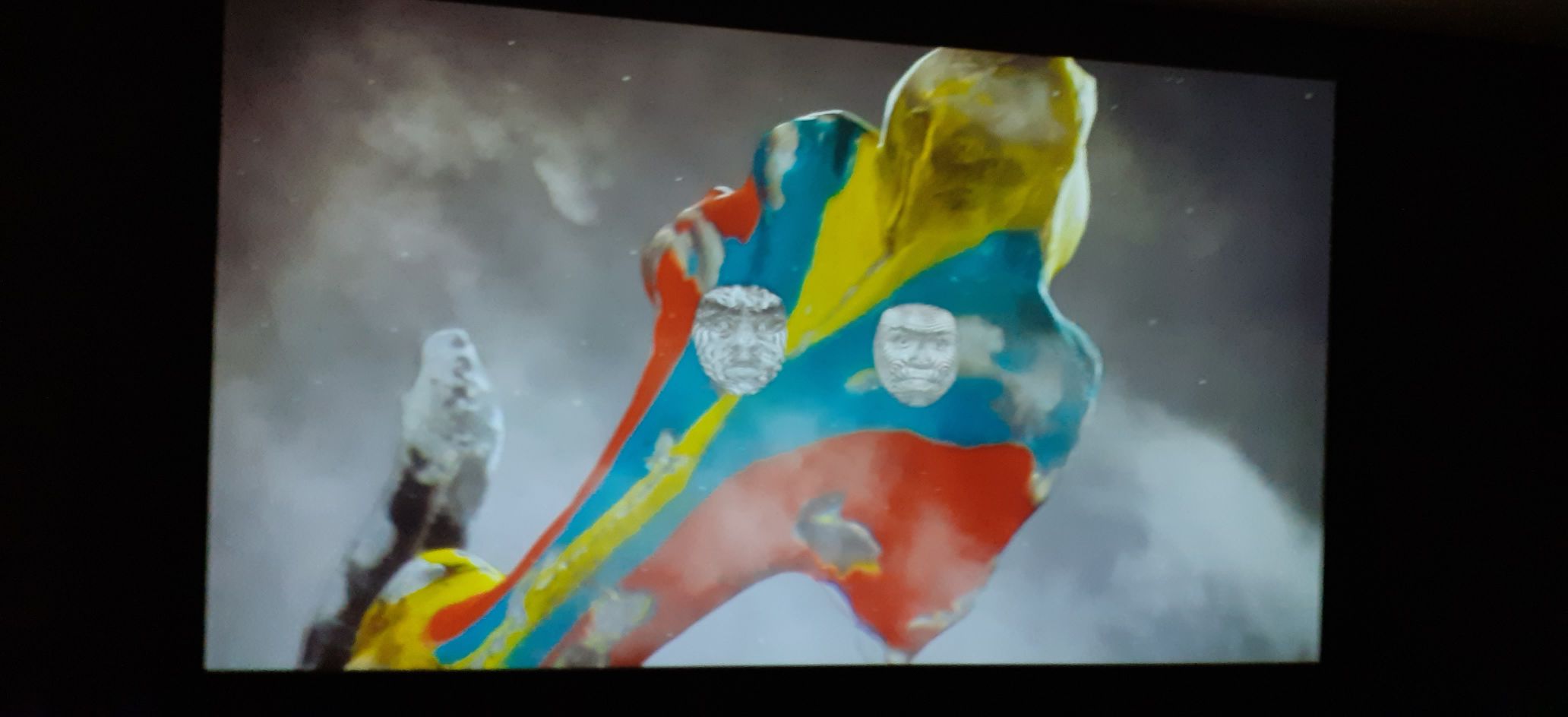
The French-Caribbean artist, Julien Creuzet has made a poignant and profound video that utilises imagery, sound and words to great effect. It is narrated, or rather, sung by a disembodied head(s) that floats dreamlike on the screen like a Greek chorus telling the story of fire, of fog and the spirit of the diaspora. It’s a pertinent theme now.
Julien Creuzet, Ogun, Ogoun
The flower paintings of Precious Okoyomon, bright and with vibrant colours, really grab your attention, as though three-dimensional. The life-like flower heads are comic and sad equally, foreboding in one painting and shocked in another as though someone has creeped up behind them and pinched their bottoms, if they had one. No need for words here as they easily build a narrative just by look alone.
Precious Okoyomon, Zoomorphic angelic beings singing in midnight sugar storms
Though born in Nigeria and resident in London, Ihenua Ellams’ pen picture and written poem next to it smells to me of a very Manchester scene. With the rain, the squashed, depressed heads buried in the pavement either side of a twisting road, the high-rises behind and a bus floating in the air above. You could mistake it for Oxford Road. The poem next to the drawing could be a tale of any city-scape but lines like “The rain clouds will gather” and “Such beautiful sorrow”, speak of the northern Rainy City it’s inhabitants have grown to love/hate.
Ihenua Ellams, Fuck/Concrete
Vivienne Griffin’s digital/graphic film is a dystopian affair fronted by what the video gamer will know as a ‘first person shooter’: a hand pointing a machine gun. We are in a human unoccupied environment populated with large three dimensional words and objects, like candles. Sometimes the scene is devoid of anything as the gunner moves through the landscape, firing balls from the gun with a bad aim. Occasionally a ball hits an object but too far away to effect anything. The machine gun moves closer and a game (of sorts) commences as the shots begin to knock the object over. The whole thing is frustrating and seemingly pointless which may actually be the point, given the piece’s title. A fake environment for a fake culture? I haven’t a clue.
Vivienne Griffin, The Fake Haven
I may be a jaded, cynical atheist but I do believe that ‘spirit’ is something akin to self-consciousness, not a ghost in the sky or some unknowable entity directing our lives. If so, then there may be hope for us yet, though I doubt it.
Outside my existence though inside my sense-experience lies a table within a jungle of sound
Objects of being in their own phenomenon their existence is confusing they just present themselves with no meaning
Just there but words and a kind of interaction presents a way forward as I am a phenomenon also
Its a fascinating subject
Wooden table faded a green bottle of used wine various objects female paraphernalia large teardrop bulbous glass with w somerset leaning over wordsworth on a lower rack
A table of scattered confusion inanimate objects sense is one thing existence another
The greatest thing is you don’t have to be a head doctor we all give head
With a wave of soft music a sandstorm of a table shell ashtray that i’ve not used
Some empty wine white and crimson with evolution on the stereo
Rent book and comic book distractions both solvent on the table
How do we perceive again and again do we put things together as before do we understand what we see or is interpretation a guise?
The same image can be perceived in many different ways life is not a jigsaw puzzle its more complicated subjective reality means we cannot answer for you, them, they so yes interpretation is just a guise







 Kevin Nebula