Planetary Nebular

Planetary Nebular – PDF

1

Deep deep is there any other way to describe it because I don’t know but it’s
beyond deep freeze and motionless because of course there is no time I’m just
speculating anyhow but we are told hold on here are some waves this really
is a vast place there’s oceans of space and now I think I feel some movement

From nothing to something no matter for black or white it’s all required and
it doesn’t matter because it is matter after all that’s formed just think all this
potentiality can lead somewhere and the progress as we all oscillate together
in giant clusters and create dubbed cosmic ripples becomes gaseous forms

Dense impenetrable glowing fog the temperatures rising and explosions of
fireballs expand to form a cloud of incandescent gas penetrating a nebular
galaxy and it is from within there that I feel some kind of critical density do
you know stars pass in vast numbers through nothingness as I reach………

Some kind of atmosphere but it all becomes perceptual soon enough still dense
nothingness but also deep humming maybe something yes a sphere out of nothing
ness and motion that creates life and of course the impenetrable star blowing
forth of rays of energy we have placenta our spinning globe planet earth we here

How can you explain but seemly from nothing came something we are all made
up of everything up there here or wherever space is but us see
everything became textures degrees of something and thus we get rock and
water thus solids and the air to breathe beings in the ordinary sense do exist

2

Now drifting for it seems like ages but how do I know what time is I’m like a
new born baby I am a new born baby and everywhere is blue and yes there is light
too much water though this atmosphere is changing so often once it’s dry windy then
torrential wet what is that yes but we all move and some kind of potentiality

There’s a curvature I can see it in the horizon there’s an afterglow in the sky at night
happenings out there in the deep deep impenetrable some forming and everything’s
like a balloon the boundaries have altered quantum fluctuations blown by inflation
and the variations on this planet are expanding a right old nebular humdrum activity

Billowing in the wind and the rain was put to good use seasons become settled
and to roam alternating nature such variations of colours in a blur and the impression
before me bearing fruits of joy and how on Earth can all this come from nothing
or seemingly nothing from the depths of timeless state and this begs the question

Lifeforms why if are they here similar in nature or differing in form I must soon see
because I have eaten my fill the apple and pear near to perfection soft and bright
beings of motion are near for now a new sensation that tingles my mind through the
foliage green expanse a voice to those silent fireballs in the sky lifeforms just are

Sound also oscillates comes in waves depending on which lifeforms volleys forth
brief ontological phenomenon before me animals scatter through nature this is
our home dear evolved humans and there could be perfection if you look and I do
and I see subtle limbs and graceful movements the human form this would have

Been the time when reproduction would have been a strong inclement and then
came more energy to the cause and this motion gives me the idea of the deep vast
nether land of yonder and how movement formed this nebular to equate it with this
specie activity and I wonder will something come of this too

Performing actions in order to achieve something the odyssey of consciousness but
which came first no matter it’s here we’re here and now the questions will arise
because there will still always be chaos collisions and from time to time critical
density to probe the intellect I’m thinking now the subject’s as vast as nothingness

3

Round and round we go out of nowhere going somewhere or at least stationary
in movement how do we work it out where do we find springy matter how do we
have it this is eternal and I we you them him her the starry dynamo and oracle of
destiny do we oscillate or is that the universe big or small every question is valid

The sphere can be defined as circular indeed one of our better inventions the wheel
we use nature to influence or we did but we should because everything came first
from there some looked for the forms in nature to recreate for our own comfort
we have done that to invent (what does that mean) means to copy means to exist

But we misinterpret all the time and because of this we have disasters natural disaster
so they say who’s kidding who now to concentrate on man-made errors and beg the
question is it natural or human thought is not perfect after all either way who needs to
know why lets just work it out together I can see you you can see me

So how do we act now we see each other when we meet person to person animal
to animal we evolve our chat we can be outwardly pleasant in nature the beauty of
beauty things are brutal death for food strongest are fittest I’ve seen small die big gets
away with it but when the mind becomes then size doesn’t matter remember

Its all matter observable and in space so its clear what we have to do scriptures say
so inquiry into whether there is a set way for individuals we act as we please is that
all bad because I know I do it sometimes detailed instance no set way because if I like
you you may not like me but if its set as in law then you must like me see what

I mean every action is random in context but everything’s too self conscious
you see primate we see and table out situations as deemed fit but how do we each
sort an action in focus arm moves out slowly uses this bodily tool to obtain planetary produce live within nature through design and that’s another topic of human activity

Using our limbs roaming through beautiful nature mountainous rocks leer to the sky
passage through and green all around if bodily needs satisfied now animal desires are
stirred love is said to be an emotion I look at it in motion far above one couple under a
street lamp glows orange an embrace wet cheeks the nature of the beast

The pain of a heart is never worse that when its explosion love is like that and nothing
lasts forever the nature of the beast she was crying because he left her I was crying
sometime too you have he has she is now but it wasn’t always that remember the high
feelings when together limbs move through nature brief scenes of joy

But we had to accommodate for brief joy we construct and protect against the
elements high structures low opposites we find our nature is not same together
because everything’s variable random one hundred thousand sperm we propagate
for those brief scenes of joy we do it over and over again overload

Load overload upon overload load we can’t sustain this anymore eternal expansion
may happen up there doesn’t mean its a good thing baby because now there’s critical
density which is it the end who knows about that but this consciousness may give way
to another or nothingness nothingness apparently the universe lives longest

EPILOGUE

This cosmic background is a story of evolution movement movement and everything
does this way we get by on a giant performing stage introducing the late great
Mr Time the only concept running I’m asking the question are we extraterrestrial did we climb the stars as we exist why should we not know about it oh cloud of gas

Incandescent gas of course this human life is a planetary nebular we glow and we
spread misty objects in the heavens particles of nature hazy light irregular darkness
good bad all opposites and everything in-between nature as seen through a screen
I started and now I’m finished and we’ve come full circle

Big Sur, by Jack Kerouac

kr

An interpretive review of Kerouac’s Big Sur

A laugh that dully sinks into the wood of the cabin while the flicker from the gas lamp almost dies amongst the garbage of wasted life.

I wander down to the roar of the ocean in the dark tripping and hopping over the descending landscape of reeds rocks cavities everything

and sit crevice like in the sand before the crashing waves waves that tell me that everything’s an eternal circle that you’ve lived before and again

that your laughter becomes a retort a life giving retort to the endlessness of everything and a life giving source to yourself.

The End.

The city and old friends and the shit they provide is the new Dharma a meditation on crazy a meditation on deepening loss of control

of contented deep knowledge of the other and some kind of internal touch spiritual yet sexual or an ideal based on an ideal.

But then theres calm not quite resignation a sense of closure that this love won’t happen that Jack will go back home settle and write again.

And his explanatory language blows like stardust over whole phenomena as always.

The Poetry Of Bad Language

D.I.Y. Poetry Swear Slam

The Collector: Fragments Of A Life

Collecting amounts to being capable of living of one’s past. But he rejects regret, that other form of hope. He is incapable of looking at portraits.
Albert Camus

Where does a collector belong in society these days? The kind of person who stores experience, who is convulsed with every slight, racked by a solitude that can only come from being alone, really alone. Even at work.

I’ve had a few jobs in my time. A collection of hours stored up in the bank, because that’s all it ever was in the end. I have never achieved anything in any job I’ve ever had. I thought that’s what happened when you grew up, I thought you ‘found a career’ or ‘settled down’. It was only when I was older that I realised that things never happen in the way you were told they would. I was a late developer. Not any more though, I think I’ve developed too much now, people sense it and are frightened. I feel them shrink from me.

I don’t know if I’m dreaming. Maybe its me that shrinks from others. I can’t deny it, but I don’t know when it first happened, when people started to scare me. This is the crux of the matter: I realise that if there is anything important in human existence (and I’m just not sure that there is) then it will be human relationships. This is because there are only two realms in which we exist, the first is within our own subjectivity, the second is within the environment of the other, the ‘objective’. We see our own person through another, we project our own self onto the other and we see the reflection. It can be said that in looking at someone else you see only yourself.

That tree is the other, that brick house is the other, the man walking down the street before me projects his life forwards and mine follows. I have found recently that I am lost in the tail of life, or more often drowning in the face of it all. I cannot see myself in anyone else any more. And I am still no closer to the answer to my question: who is shrinking from whom? In a decent society the individual should be endowed with responsibility, this should be sovereign along with whatever ‘freedom’ circumstances dictate. Because this freedom we have no matter what. Without responsibility the freedom we do have is tainted. Wider society has failed but I must look to myself, to my own responsibility.

I can remember a time maybe seven or eight years ago when I wasn’t nervous in doing anything, especially talking to people. On reflection life drifted aimlessly past, and it wasn’t that I didn’t have any plans either. If they did come to fruition then it was slowly. And even as I write now I can see that that was the problem, it was a kind of inability to act. I always did what I had to in life but over the years it became harder and in the end I sometimes wouldn’t do the most basic of tasks. I would stay in bed all day. Still do sometimes. But before this I remember having a job on the phone all day, it wasn’t up to much but it didn’t bother me at the start. Back then it was still almost novel to work in a call centre and it wasn’t always that busy. I never intended to stay in the job and I didn’t when I left to go to college. I couldn’t finish college and eventually found myself back at another call centre taking clothes orders from customers. People are ‘customers’ now.

Things were different, life didn’t drift aimlessly past any more, time weighed me down, I had become increasingly shy and on top of all that the calls kept coming. I guess this was the time I started collecting, bringing together the scattered episodes of my life, collecting unseen moments out on the streets or in the pubs. I was collecting orders but it turns out I was also collecting bitter memories. I was caught in a vicious circle, becoming isolated and at the same time preempting my self-conscious attitude towards others. I would mumble hello looking at your forehead or I wouldn’t even look at you at all.

Why? I don’t know, I have to think about it.

A child needs confidence; but I think this comes from the innocence (ignorance?) of young life. I’m certainly not a child any more but I was once.

But all of this is tosh. I have a secret to divulge, I’m sitting on it now. It all started for real during my second foray into call centres. I realised that I’ve never talked to so many people before, everybody sounds the same. Call after call, people were phoning me, at least I liked to think so, but I was so impatient with them. I hid it well until I exploded. I mean people phoning up and not knowing what to do; god, who are these people? Who buys clothes over the phone anyway? How do you know if the fucking things fit? You know the colours aren’t the same as they are in the catalogue and the sizes are ‘generous’, not the sizes stated in the catalogue? Who’s fooling who?

One day I decided to ask a customer these questions. I got carried away with it all, I lost myself in my fury. I didn’t notice that she had hung up, I didn’t notice that everyone was looking at me (I was the centre of attention and I didn’t even know it). I walked out and never returned.

But I was stuck for something, I was also stuck for a job. What could I handle? That was when I became a collector for real and I was still with catalogues, dropping them off, picking them up, walking the streets, knocking on doors. Granted I am the butt of the capitalist joke but what the hell, I am now in the open air. I feel different now, maybe I got too much air but something happened up there, if you know what I mean. Solitude can do strange things to a person but when you mix that with insignificant meetings and failed interactions….well I’ve exploded. I haven’t got many sales, household goods don’t go far. “Earn so much an hour” the advert said; again I ask the question, who’s kidding who? Anyway I’ve had a small look into other people’s lives and it’s surprised me that I am even interested, after all I have cut myself off from social interaction. I explained all that at the start of this fragment. Or I explained that we all should have responsibility….well fuck it, I’m too weak, responsibility is a burden and I just don’t see anyone carrying it out any more.

What didn’t surprise me though, was that small glimpses were never enough. I began to plan scenarios where I could come into their lives and it became a frenzy in my head when I was ushered into someone’s kitchen while they looked for the catalogue. It was raining. On the kitchen table were the remains of a meal, a local paper, opened on a report about the death of a person who was on benefits until she was sanctioned, and some keys. I looked a long time at the keys until the man came back, a bitter looking old man, bald apart from a clump of white hair on both sides of his head, with pin-pricked blue eyes. He reminded me of someone, off the television or some politician maybe. His return with the catalogue, no order, woke me from my dream. I dreamed every night after that about those keys. It was the same every night, I would pick them up and slip them into my pocket and every time they would burn a hole in the pocket and fall onto the linoleum floor. The old man would stare at me and say nothing, just picked up the keys and threw them onto the table. I would wake up after that.

I can’t remember when this dream blurred into reality but it did because one day I did have the keys in my pocket, they didn’t burn a hole this time and the old man never saw me do it, he could never find his catalogue.

Here I am now in his house unburdening myself. I don’t remember getting here, it is late at night. But I must be here because I’m typing this on the old man’s black heavy typewriter, a Corona, it says. I know its heavy because I had to lift it when I dropped it onto the old man’s head while he was sleeping. I’m glad he was sleeping, I cannot guess at what I would have seen had I looked into his eyes. I don’t want to see nothing but the thought of seeing me chills me to the bone.

I think I’ll search his house, I need to collect new memories now, now that I’ve erased mine. God, some people can be so self-obsessed but at least I’ve done something now, at least I’ve finished the job.

Melancholy

1

even the name prompts a deep muse
deep breath and your torso expands
softly you blow your cheek out like a bruise

what to do with your mind then
like a deep blue sky blotted with
pure white clouds in the expanse of a glen

the broad scenery surrounds you
much traversed from far ashore
limbs are tired and feet are sore

melancholy through to the bone
like an inane sense of folly
a long, long way from home

2

stopping on your way deep in thought
where does one go from here?
your ideals and your hopes have all been bought

in time everyone wonders if they are lost
and can it be that we are or does this
world deceive? in the distance the mountains are capped with frost

walking you feel softly in your breast
the flutter of a temperate heart
it imbues your melancholy with a rhetorical tart

that your mind rejoices at the inherent emotion
which must lead to a voice of nature
within you that at once fatigues you like a potion

3

back you sink into the numbing sphere
of melancholy feelings
it leads your mind to fear

the dormant motion that resides inside you
like an immense weight drops
that forces you to sink down too

but one must fight such expressions
to force with all your might
to rise heaven-wards that you might express

so what is melancholy to a wandering
spirit such as yourself with no hierarchy?
we must all swim in a sea of anarchy

4

No but that isn’t the way of a real melancholy
because a person finds it hard
to focus in on a wandering mind
a mind that drifts so and you are melancholy
because there is no substance to fill in the pictures

Melancholy is a puzzle it has no rhyme
the poet looks for this
creates a style from the natural forms
around and maybe it has no rhyme
but it is for the reader to enjoy because
the poet is melancholy
the poet is bored

Conkers

1

Looking back I left because everyone I knew had left and I wasn’t prepared to hang around anymore. I’m someone who finds it difficult to face up to problems, someone who finds it hard to look reality straight in the face. Or maybe my reality was distorted? But there was one thing I could never run away from and that was my own existence.

It was both reckless and necessary to go on my own to America. I did it in my true fashion by giving up something that could have benefited me had I treated it right, if only I had staying power. But I’m a hopeless romantic and romantics never stay in the same place. With this in mind I decided that it was time to be on the move, to go somewhere different. Of course America wasn’t all that new to me, or so I thought. I became fascinated by the schizophrenic, even hypocritical, nature of the States. In one glance I would see great things; I would see how a person could do things that you think could only be done within a country that was fully developed, a country that you think is fair. But then you realise that there is no such place, that fairness comes down to the individual, and that what one person thinks is fair another would think unfair. America is a place that has both attributes of good and bad in explosive amounts. With an irony it was this ambiguity that I was looking for. I was thinking that once a person finds where he’s at has lost its feeling, has lost whatever it was in the first place that enticed them there, then its time to move on.

I had lost that feeling and all that was left was solitude and emptiness. Today I have visions of a distracted globe, of a disjointed people roaming the earth in search of something, searching for their goal. Happiness is a potent force.

Anyway, I was to join the masses searching for that elusive talisman that would make me whole: searching for myself and the meaning of my own existence.

2

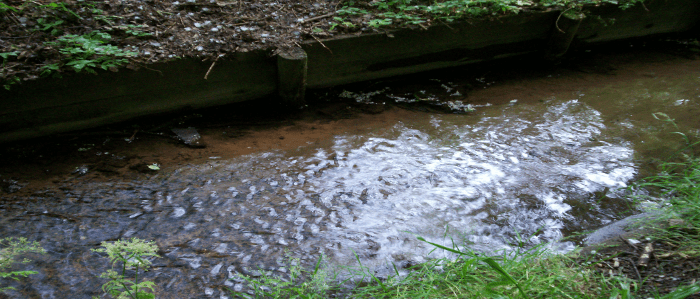
So one day I found myself out taking a walk by a stream. It was a particularly cold day for the middle of September and I could remember the bruised sky leering down at me. The stream was trickling by, small currents parted by the flotsam and the garbage rooted in the shallow sandy bed. It was then that I knew I had to go away; I had a loss of faith when I looked at the familiar signs of nature surrounding me. Tall, solid trees with their thick sticky leaves that in my youth I would have used to ease the burning of a nettle rash, protruded towards the low sky. Large horse chestnuts lay abandoned around my moving feet. I was dimly aware in the back of my mind how I would search for an age as a child for chestnuts the size of these, and when I did eventually find one, would steep it in vinegar and then promptly lose it in a game of conkers through my adversity’s enviable larger conker.

But that wasn’t the name of the game anymore. I was impatient and frustrated, I wanted a new perception on a world that had gone stale, and then maybe I would begin to learn about myself. I knew that I couldn’t do it here, that what I needed was an adventure. Awfully childish, but I wanted to lose my innocence.

Sitting on the edge of the embankment I knew that the first thing that I had to do was to get a job so I could finance my trip. The stream became a little louder as a diversion in its pathway provided competition for the bubbling water, and I became aware for the first time in my life of how significant the choices you make can alter your life. Whether it be good or bad only time will tell, but, just as a stream eventually flows to an end so an individual can have an afflux of choices taking you on a winding path to its inevitable end. I became aware of my choices and that I could make them too. This thought lightened my step as I made my way home. My goal was in the future and that old chestnut of destiny guided me there through the choices I made.
stream

3

A week after my sojourn by the stream I managed to get a job in a warehouse loading and unloading HGV’s. In a way this was a good job to have just before a long trip as I didn’t have to think about what I was doing, it gave me more time to get excited and plan my longer sojourn to the States.

No, it wasn’t a job that I’d want to do for a great length of time. When I was there I mixed with some people who had been there for years. In a presumptive way I felt sorry for these people and the subjects they often talked about made me shudder. But who was I to judge, if they were happy.

I was part of a number of people who the company employed for a temporary basis over the Christmas period which ran from September to late December. The majority of the temps were my age, and through them, and others, I began to consider just what this happiness is. I looked about me and eventually saw and differentiated between those who looked happy and those who just got along. It was rare to see people visually unhappy in this place, you felt as though there was a grim contentment generated by the necessity of working.

This made me think about how I would observe people when I was walking outside. Everyone’s features always seemed bland and fixed, as though, like you would put on a coat before braving the cold wind you would also arrange your face, so as to step out into the world. People today have become too afraid. I guess part of it is because nobody’s sure of the next person; when I say we are prone to hide our emotions this is magnified by our reactions in public when we see a person in obvious distress. This blatant show of emotions has varying effects on different people. Some of us, being honest, would shy away thinking that the person is disturbed, shy away because the emotion reminds us of ourselves, of being defenceless.

It was the power of these emotions and their paradoxical nature that gave me an interest in my new environment and the trip to come. Paradoxical because these emotions are what we all crave for sometimes, and the thin line between the fear and joy of these feelings is so acute a person could go quite mad. At the warehouse I found many examples of people using their emotions in different ways and in different situations. I found that, even though out on the street people hide their feelings, people would become more open in an informal environment. And when any set of people all have something in common, albeit however small, a person’s openness becomes more familiar.

4

At the warehouse we all had that one thing in common: the necessity of working; but I was becoming increasingly aware that this necessity was only a means to an end, that, after all, everyone is aiming for that same thing, happiness. Or contentment in their life. The first person I met was an older man in his late 30’s. He was a small stout forceful person by nature but really harmless. He was sitting in the small undecorated waiting room by the reception when I entered on the first morning. I sat down and we spoke straight away, or he did.

“Alright, mate? Bloody ‘ell this place’s a bit dire, ain’t it? Still, shit, I need a job. The wife been on at me, so I think I’ll just get the hell out and get a job, on and off the dole, you know”

And he would talk on like that for quite a while. I would not say much, only when I really had to, but he didn’t mind. It would take me a while to respond to someone at times when I didn’t feel like speaking, but I knew that I would in time. Anyway this guy couldn’t keep talking forever.

“So I said to her that most jobs are temporary at the moment, you know,” he continued, “but really I get lazy, you know, and sometimes I just like to sit around the pub, you know.”

I knew the feeling of abject listlessness. Weeks before I came to my decision to travel I had spent many afternoons in one pub or another just drinking but never really getting drunk. You need the mood and, sometimes, the right people for that.

“So you don’t get on with your wife?” I asked.

“On no, I do,” he said. “I love my wife deeply.”

This frank assertion shocked me at first, though only because I wasn’t expecting that answer. He was quite animated as he told me how much his wife was his rock and that they only argued because they are so much alike.

“This is why we met,” he said watching me from the chair opposite. “When we were young we would agree on almost everything, and when we were out I would always know how she would react before she did. She’s always disagreed ’bout that, but that was all part of the fun. I’m not too sure of what she feels these days but I still love her, I guess,” he finished as another small middle-aged man in worn grey trousers and a black bomber jacket covering a white shirt and a ruler tie came in. He was the supervisor and came to lead us to the warehouse floor.

5

We were led down a small narrow corridor which led to the floor. Me and Mick were assigned to Depot 1 and as we were introduced to the other people I reflected on the strange (to me, at least) relationship that Mick and his wife seemed to have. I think he was happy but at the same time I felt that he was waiting for something.

warehoue_bayThere were two other temps on my depot and about three permanent workers. The loading bay had a wide façade; number One was at the near wall close to the canteen and reception and the floor had twelve loading bays. The bays filled out into the back of the main warehouse where all the stock that was to be loaded was stored. My job at Depot 1 was to load or unload the HGV’s as required. Nothing thrilling about that and as soon as me and Mick were led round to the bay we got to work. The monotonous routine led me to forget which lane to put the numbered cubic boxes so I eased the monotony by listening to Mick talk about his wife.

A guy about my age was working next to me. He had short, cropped blonde hair and he wore a smart sports sweater. It looked brand new and he didn’t seem to mind that it was getting dirty. This was a dusty, dirty job as well as being heavy on your arms. I made a flippant comment on the filthy nature of the job.

“Yeah, these boxes are really dirty, as though they’ve been in that fucking lorry forever,” he replied. His name was Chris and he spoke in a slow manner with a lot of expletives. The swearing was not a problem, in fact par for the course in any warehouse. Anyway, when I wanted to I could swear with the best of them.

He seemed approachable enough so I asked him if he minded getting his clean sweater dirty, it wasn’t the job for wearing anything clean, really. He looked surprised as though he didn’t know what I was getting at.

“Oh, eh, well I don’t have any dirty clothes really, my mum washes them quite often.”

Chris was still living at home with his parents and during the time that I knew him, every day he came in with a clean top on, sometimes the same top as the day before but freshly washed by his mum. I got to quite like him and we got on well at the place. We would make up names for the different people who worked there, not everyone just some of the people we thought were distinguishable.

One such person who was working in the same depot as us we called Hero. He was a chubby cocky guy in his early twenties. A temp like us he would always volunteer for every job going even if he didn’t know how to do it. Me and Chris would have hours of amusement watching Hero and even encouraging him to do amazing feats of daring. He would always oblige and leap onto a mechanical fork-lift, usually in the late afternoon while we were waiting for another delivery. Me and Chris would also jump onto a fork-lift and would chase after Hero, narrowly avoiding major disasters because we kept forgetting that you had to steer in the opposite direction that you wanted to go in.

Hero was already married with a kid and another on the way. He would take any opportunity he could to help himself which was understandable considering his circumstances. Every two weeks he would disappear during an afternoon to go and sign on, then after a while he disappeared completely. We thought he had probably got a job elsewhere. Jokingly, we said he had probably applied to star in Superman.

Chris liked to do things as full as possible, while I was there he was very exuberant. It was he who started making up names for people and his yin yang with me enticed me to join in. I named Hero, though. I only knew him for three months and just before I left to go to America I heard that he had gone to prison for assault. I was surprised when I heard even though he did tell me of a fight he had been in, though not of being in court. Possibly Chris was a little bonkers.

One other person I got to know a little was a young dark-haired kid just a bit younger than me and Chris. We were all kids really, inexperienced though growing more experienced by the day. This was the reason I was doing this job, I thought. I felt that everyone here, especially the temps who were used to this kind of work and duration, seemed to drift between work and play in alternate amounts. There was no scale for these people, myself included, we hadn’t found the balance to suit our own scales.

His name was Alex, the dark-haired kid. He was frisky in nature but also had some reserve, or maybe it was satisfaction. I could never really tell in the end if he was satisfied but during the time I knew him at the warehouse he would act expansively and passionately, but never too much. He would listen intently and would be decisive in his decisions. Not that any of us had to make many decisions at work but Alex showed the potential of knowing he was right for himself. Maybe he knew his own balance.

The comparison between Chris and Alex was slight but acute in the issue of balance. Chris was always boisterous but I felt he was lucky at times and showed that maybe he was still trying to find his own limit. But essentially and maybe mostly with Alex being the youngest, we were still looking. The warehouse was a large caricature for this. At times though, I could see the confirmation in someone’s eye of being settled, it looked gruesome to me but I was locked into my own tunnel-vision, always forgetting that what suits one person may not suit another. I realise that we are all guilty of that sometimes.

6

Anyway four months eventually past and it was time for me to embark on my journey. I was excited and had my plane ticket and also a bus ticket for the road once there. A day or two before I left I once again took a stroll by the stream. It was early January and there was snow everywhere. This was very unusual for this city as it would be more likely to rain. But nevertheless we had four inches of snow and as I walked among the bare trees by the stream I saw how pure the snow was. It was early morning and the snow was untouched apart from my footprints, the sky was a clear blue becoming more intense towards the middle and this added to the frost and the great billows of breath around my head as I breathed. The sun was low, simmering behind me as I moved along swiftly, gloved hands deep into my warm climbing fleece, the stream trickling between partially frozen ice and great clumps of snow, by my side.

I thought about my trip and realised that amongst the excitement, at the pit of my stomach was a little dread. I reasoned it to be fear of the unknown because one is never sure of how things end up. Looking back to my youth, I didn’t win many of my conker matches, most of the big beauties I found and steeped in vinegar ended up smashed on the pathway. Once, though, I won against my conker playing nemesis, a large kid called Declan, who always had the strongest nuts.

It was a spontaneous meeting by a Chestnut tree-lined stream near to home, Declan had just won at conkers against a younger kid and was boasting. I picked up the first green spiky covered conker I came across to challenge Declan. It was a small one that I would normally ignore. I had string and a sharp nail in my pocket (always prepared!), and proceeded to pierce a hole through the middle of the conker and string it. We all cheated at conkers by hardening the nut, though this time I had a fresh nut, Declan’s was his year old hardened nut that had won countless matches. I was 10-nil down in matches and with my first hit I was 10-1 down but Declan’s conker was smashed on the floor. We both stood in silence looking at the remains. With no planning, no thinking about what was to come, I had achieved something I hadn’t done in two years, beat Declan at conkers. In reality his conker wouldn’t have lasted another hit, time had caught up with it, but it was my first experience of chance and luck.

As I went home to pack I thought about this childhood event, I thought about what this meant for an individual’s destiny. By going away I wanted to see how the individual fitted into the whole, that is, if there was even anything to fit into. I really wanted to discover who I was but, because of that, I knew meticulous planning would only construct something false. If I wanted to find myself, to achieve anything of worth I had to let spontaneity have a role in events and to let events play themselves out. You are yourself automatically.

Two days later I stepped off the plane into San Francisco.

Muthos and Logos: Art as Origin

The Parthenon, Athens, Greece

The role of myth in Classical Greece was an attempt to describe, in its explorations, the nature of reality, both physical and psychological, and while myth in drama and in story-telling, by the nature of its transmission, was a form of escapism for its audience, the use of myths by the time of Plato gained a moral force at odds with any such desire to escape from life itself. In this piece I wish to explore the symbiotic relationship between muthos and logos by examining three areas where myth and reason mixed: in origins, with authority, and in theories of the afterlife.

The Origin according to Art

Martin Heidegger, in an essay titled ‘The Origin of the Work of Art’, explained ‘truth’ has come down to us today from the Greek, alētheia, meaning ‘unconclealment’, he also said that ‘To be a work [of art] means to set up a world.’ What does he mean? He is saying that we know the ‘real world’ through art. Logos means word and words are the poet’s fundamental tool. In the hands of one ancient artist, Hesiod, we learn of the birth of the universe and earth herself, where the gods reside on Mount Olympus:

‘In truth, first of all came Expanse [chaos], and then
wide-bosomed Earth, seat ever safe of all
the immortals………

From Expanse came Darkness and black Night;
and from Night came Ether and Day
whom she conceived and bore after joining with Darkness in
love.’
(Hesiod, Theogony)
(trans. Barnes, 2001, pp.3-4)

In this truncated excerpt we come across what philosophers call a first principal, the coming into being of something from chaos. Further on in the Theogony Hesiod does something interesting: he personified natural and psychological phenomena with the gods themselves, for example, Oceanus for water, or Aphrodite for love. The beginnings of cosmology held a debt to the theological myths of the gods, this ursprung of reason came not from isolation but from the varied oral culture of mythology that allowed thinking itself to develop.

If one was to accept the eminent classical scholar, W.K.C. Guthrie’s claim that with the pre-Socratics Greece was to abandon the search for alētheia by the use of myth and to continue on using only rational thought (whatever that is) then we would be left with a sterile, if not entirely correct, vision of the past. Yet the Ionian philosophers, in the guise of Thales and Anaximander, took much from Hesiod’s style and combined their ‘rational thought’ with the need to explain or describe things. What did the function of myths have to do with this? In the first place myths explain, they give an aetiology, to describe the causation of things, and it was this cosmogony that Thales appropriated when he said that all things were of water (that is: water is the origin), we know this from Aristotle who said that Thales came to this way of thinking through looking at nature and seeing the preponderance of water, using the empirical method, possibly for the first time. It is not a long shot from that to think of the Oceanus myth. Anaximander, as Thales’ pupil, continued with his own arche, moving away from his teacher by claiming that it is the ‘boundless’, or apeiron, that is first principal, not something physical but, rather, metaphysical. With these two thinkers we are presented with the beginnings of scientific thought, bringing in the empirical method, the idea of substance, and the surprisingly liberating concept of metaphysics, and yet this ‘world of proto-science still seems imbued with the language of myth’. Far from trying to ‘escape’ reality the classical Greeks, like Heidegger’s artists, were making reality.

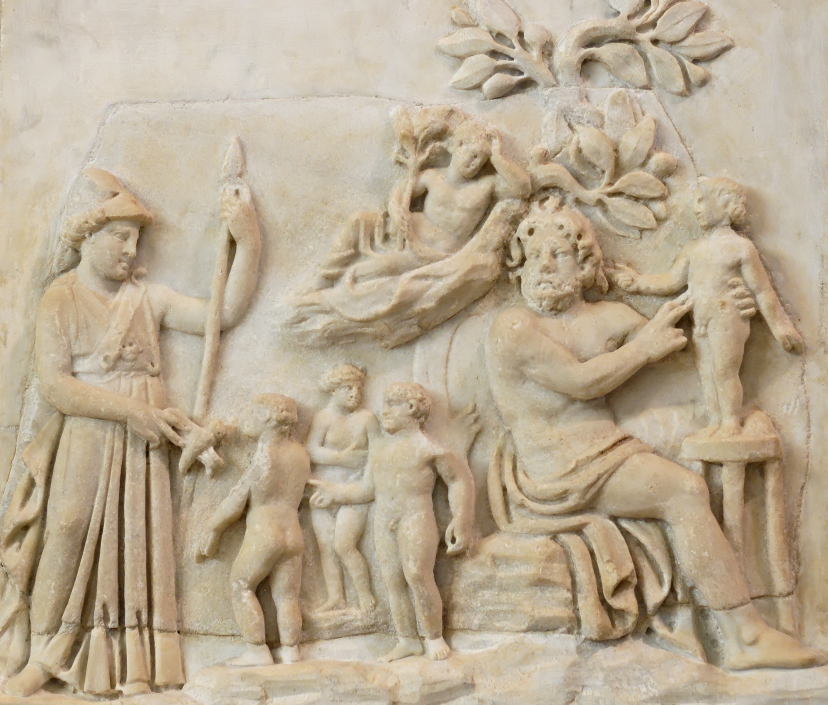
Fantastical myth still played a strong role in myths of origin, but in particular in the origins of mankind’s achievements thanks to Prometheus (see image below). We know that this god, cousin of Zeus, created man and brought fire to man, and that he was the protector of man, usually from Zeus’ wrath, according to Hesiod. While his battles with Zeus are interesting for their own sake, there is something else of more significance that is told in Prometheus’ myth, and Ovid lets us in on it: ‘Where other animals walk on all fours and look to the ground, man was given a towering head and commanded to stand erect….’. One can easily extrapolate a nascent evolutionary theory from this myth, especially the theory that the discovery of fire allowed humans to leave the trees and to kill and eat cooked meat, enabling the brain to grow and man to become more intelligent. Here we have a perfect example of myth preceding scientific theory.

Creation of humanity by Prometheus as Athena looks on (Roman-era relief, 3rd century AD)

Reaffirmation of Authority in Art

In the later Roman period we learnt that myth was used by authority for control and elevation. Preceding this in classical Athens through the character of Socrates and the words of Plato we are confronted with a questioning of, not just the myths and gods, but also of the nature of knowledge itself. We know that Socrates commits suicide by hemlock after being found guilty of ‘corrupting the youth’, and that the greatest knowledge he had was that he knew nothing at all – well, actually Plato never ascribes these last words to Socrates – but in the dialectical method (also known as the Socratic method) we learn that not everyone knows why they claim to know something, an activity that was seen as very threatening to authority: powerful people cannot bear to be ridiculed, or worse, to be seen as not wise. In the Apologia Plato sets out the case against Socrates and a defence of him, in the former that he denied the gods and was only interested in ‘what is beneath the earth and in the sky’, and in the latter that he did not deny the gods, he preformed religious practices, and claimed that any advice he gave was ‘at the prompting of the divine’. His bone of contention was that he found it hard to believe the stories people tell of the gods, not the existence of said divinities, but the power of mythology was so great that even the possibility of creating new gods was akin to declaring war on the established powers.

Socrates wasn’t beyond being ridiculed himself, Aristophanes’ Clouds made fun of the charge against Socrates that he was interested in what was in the sky: for Aristophanes Socrates walked on air.

Death’s Representation

If myths had an aetiological function then nothing needed explanation more than death and the afterlife. In book 11 of the Odyssey Homer tells us about the underworld and what happens to the dead. We are presented with ‘an ill-assorted lot’ containing all people in one place (Hades) including those who are being punished: we see Sisyphus rolling his rock, and Tantalus being tantalised, all the while Hades and Persephone preside over this world, seemingly unaffectedly (seen in an Apulian krator below). There is no judgement in this version of the afterlife, Minos as ruler of the Underworld adjudicates as one would on earth, except he is acting on behalf of disembodied spirits who ‘while alive, drift aimlessly and joylessly in the gloom; the light and hope and vigour of the upper world are gone.’

The Underworld, Apulian red-figure krater, Ca. 320 B.C.

It was the amoral nature of Homer’s representation of the Underworld that annoyed Plato, not that myths existed but that they were put to bad use, and ironically (considering Plato’s Apologia) corrupted the young and impressionable. While it could be argued that Homer’s amoral world-view is an attempt to ‘escape’ the world as we know it, with Plato we are at the dawn of morality, that ‘doing good’ is good for its own sake and is reward enough. Plato’s Republic is a dialogue on the ‘just’ state, on justice and ultimately on morality itself, but it is also about the way to this just state by the education of the populace. Following on from Socrates’ scepticism of the tales of the gods iterated above (though not of the gods), in the Republic we come to understand Plato’s dislike of Homer’s tales of the gods: that it shows them in a bad light, that even if it is true that the gods fought amongst themselves, it should not be common knowledge. The multiplicity of the myths and the chameleon nature of the gods (think of Zeus changing into an eagle to abduct Ganymede) did not fit with the stability that Plato wished for: his ‘theory of the forms’ was not just a metaphysical concept it was a contrast to the attempts by the artists to represent reality through their copies of nature. Only the Ideal, through philosophy, represented truth, the non-philosopher sees the real as though they had spent all of their time in a cave and were suddenly dragged out to face nature but were blinded by the sun (the sun represented the absolute Form), distorting what was seen.

It wasn’t telling myths that was wrong for Plato but what was told that was wrong. A Just state needed it’s citizens to fear the consequences of being bad, but equally to expect reward for being good: the Homeric Underworld gave no such guarantees, apart from lack of passion, everyone seemed as they were above ground. As such Plato created a myth of his own, The Myth of Er, to show how a myth can be utilised for the ‘good’ of the republic. These beginnings of morality can be seen in the contrast between the use of fate in mythology and Plato’s new conception of ‘choice’: man is not helpless before the gods but are responsible for their own actions. First of all the afterlife required judgement, the just directed down one path, the unjust to take another. Hades was split into two: a heaven and a hell, tyrants, no matter their outward appearance, would be judged as tyrants and would not ‘pass through’. While there is much more to this myth than I have presented here, the moral for Plato was that each person was to ‘find the man who will give us the knowledge and the ability to tell a good life from a bad one and always choose the better course so far as we can’. I can’t help feeling, though, that Plato was a philistine, a condition that defines those who moralise too much.

Far from trying to ‘escape’ from the realities of the world, muthos and logos are inextricably linked, the first gave space to the other, and they each could not exist alone. In myths of origin we confront the need to explain what is before us, the phenomena we experience enabled us to create our own world. And this creativity of logos led to the ability to question established norms, and incorporated new dialectics that were still influenced by the old way of telling stories. And the finality of death demanded description, both old and new, yet the language of myth still pervades, even to this day.

Sources

Aristotle, The Metaphysics, 1998, Hugh Lawson-Tancred (tr), Penguin Classics

Plato, The Republic, 1987, Desmond Lee (tr), Penguin Classics

Early Greek Philosophy, 2001, Jonathan Barnes (tr), Penguin Classics

Ovid, Metamorphoses, 2004, in Feeney, D (Intro) & Raeburn, D (tr) (eds), Penguin

Morford, M P O & Lenardon, R J, 2011, Classical Mythology (International 9th edn), Oxford University Press

Grimal, P: Kershaw, S (ed.) & Maxwell-Hyslop, A (tr) (eds), 1991, The Penguin Dictionary of Classical Mythology, London: Penguin

Martin Heidegger, Basic Writings, David Farrell Krell (ed), 2004, Routledge

W. K. C. Guthrie, A History of Greek Philosophy: I The earlier Presocratics and the Pythagoreans, 1997, Cambridge University Press

The Cambridge Companion to Socrates, Donald R. Morrison (ed), 2011, Cambridge University Press

Searching

I saw you the other day standing on the edge of the
pier
in the very mists of splendour as the sun went down
beckoning in the dark night
I stood and watched and wrapped my coat around
me
it was getting cold and the darkness in my heart
called out for you standing on the edge of the pier
Looking at you my mind rejoiced
the darkness
recoiled and my heart flared for an instant as West flew
a flock of birds through
the wind

In my solitude I stand at the edge of the pier and watch
the red rose float by in the water
the sun almost down I wait for you
The thin clouds towards the horizon gives a palette of
colours
and in my mind I choose your favourite colour and I paint you
standing on the edge of the pier
You didn’t come that night onto the pier to stare at the foreboding
dark waters
to watch the bird swoop
dive and catch the morsel only to fly high deep into the sky again
So I leave the pier with my arms wrapped around me
I’m cold
and I pass people on both sides as I am wondering where you are
tonight

I walk the streets but they are unforgiving
and I want you and I’m crying out without you
but there are no answers
Tomorrow
I shall be with my Angel tomorrow

I’m at the edge of the pier again and I see you there in front of
me
calling me and showing me the way
You’re off the edge of the pier
I hold out my arms but your falling
falling
endlessly falling and I’m calling your name
Angel
as you drown sinking into the depths your love goes with
you

Tonight I’m crying at the edge of the pier
the sun went down a long time ago
just like my dreams
just like you
Someone is standing next to me and I ask
‘Did you see that girl the other day?’
and you say, ‘She’s drowned,’ and to yourself
‘a sweet Angel’
I watch the water and its getting nearer and the splash is cold
but I don’t wear my coat tonight
Here I am and my Angel brings me down
down
Down to our dreams we swim

(1994)

Misunderstanding Austerity

No austerity and no cuts means no capitailsm
Does the Left misunderstand austerity’s origins?

There is a lot of talk about austerity, about having less austerity, more or even none. For those on the right this is a legitimate activity, but for those on the left who continually use the rhetoric of austerity, that they want less or even no austerity, they are making a serious category error, particularly because they do not question why we have austerity in the first place: capitalism. There are many on the left who only talk of less austerity, it must be assumed that they are not questioning the supreme place that neo-liberal capitalist economy holds in contemporary Western culture. For those on the left who want to see the end of austerity and do not question austerity’s origin in capitalism, it appears that they are misunderstanding austerity.

Capitalism Is The Ideology Not Austerity

A fundamental misunderstanding of austerity is in thinking that it is an ideology. It isn’t the ideology, it is capitalism, and in these times, neo-liberal capitalism that is the ideology. Those on the right and those who are economic libertarians, have capitalist economy as their own particular ideology and (specifically as it rarely affects them) they accept austerity as a positive within this economy that requires its downturns. Capitalist economy accords with their world view, a view that sees no value in the human being in anything other than monetary and as a piece of equipment for use in the workplace.

That certain sections of the left, if not most, collude in this ideology is unfortunate. It is also self-defeating. One aspect of austerity that leads to this misunderstanding is the way austerity is used by those on the right, as evidenced by the 2010-15 government and the current Conservative administration. Austerity is used as a tool by these administrations in order to effect a particular ideology, that of decimating the State’s provisions for its citizens. So, currently, every council in England are making massive cuts to its operational budgets leaving vital services for the disabled, sport and leisure, environment, education and many other unseen provisions, being cut or got rid of completely. Or being privatised which is death by a thousand cuts (pun intended). Nationally we are seeing this happen by the proposed £12billion cuts to welfare and the perilous situation the NHS finds itself in. Witnessing all of this the confused left have concluded that austerity is ideological instead of a tool of ideology. This misunderstanding is further compounded by its rhetorical use by all parties of the left, because in arguing for less austerity or even no austerity they fail to comprehend that they should be arguing for an end to neo-liberal capitalist economy if they want to end austerity. The Chancellor, George Osborne, knows this and is making hay with this knowledge. How? Because no one is seriously disagreeing with him on the need for austerity, only on the minutia, offering sticking plasters thinking this will revive a corpse.

Neo-Liberal Capitalism, Debt And Globalisation

At the time of the latest financial collapse in 2008 the combined debt of advanced capitalist economies went into trillions of dollars. As money is the foundation of all economies, and as debt is the machination used by fiscal economy to fund said economy, it is no surprise that the downturns in capital occur frequently. The severity of the 2008 crash has been exacerbated by three factors: 1. The criminality of the banking sector, particularly in the UK but also generally; 2. The neo-liberal version of capitalism that is in vogue today which requires lax control of the financial markets, a dismantling of government laws and services along with a bigger emphasis on debt as a tool to finance the activities of business and governments. The third, and most pernicious, of the factors that is integral to this latest crash of capital markets is globalisation which is a particularly neo-liberal phenomenon. But the phenomenon of globalisation, as William Greider presciently foretold in One World, Ready Or Not, published in 1997, would swing back at the main players (or those they govern) of globalisation, those who deal in the ‘abstract’ of trading in finance and resources. The logic of globalisation will inevitably lead to reduced living standards of all but the top-tier of society by discarding “old political commitments to social equity and reduce benefit systems for pensions, health care, income support and various forms of ameliorative aid.” (Page, 285) We are clearly in the midst of this scenario now.

Those in the higher echelons of society should feel no comfort by their seeming detachment from the problems the rest of society now faces. By accepting, if not participating in the laissez-faire nature of trading in capital, they have unwittingly set in train the demise of the traditional tools of trade: industrialisation and manufacturing. So there is a trade deficit between exports (the real value of a country’s GDP) and imports (which is usually paid for though debt). Added to this are the mass unemployment caused by jobs moving to cheaper locations and the rise of technology that takes jobs away from humans. As if this was not bad enough the next catastrophe, due to the increasing toll on the planet by burning fossil fuels and by an unsustainable acquisition of resources, is climate change leading to drought, a collapse of vital resources, mass population movements, and, ultimately, unending wars. This ‘perfect storm’ of events will ensure that the elite will become engulfed just like the rest of us, though maybe not as quickly.

The Left Failure To Tackle Capitalism As The Real Cause

The left understands all of this, they have many organisations that deal with each issue above independently. The problem is that taking any issue in society, political or cultural, individually usually means missing the bigger picture. Austerity, as the left have dealt with it, is a case in point. Yes the left would like to see no cuts to vital services, especially for the weak, poor and sick; yes they would like to see no austerity; yes to real employment with good employment rights; yes for the environment to be protected and for an investment in renewable energy technology. The one thing that causes austerity, that causes societal collapse of vital services, that causes environmental degradation, is the capitalist economy. And now, due to the economic orthodoxy of neo-liberalism, contemporary capitalism is refusing to invest in the new manufacturing of renewable energy which could help ameliorate the effects of climate change and unemployment. Capitalism is eating itself and us with it.

None of the left questions the establishment of capital economy, and yet they protest against the effects of this capitalism. Labour said before the 2015 election that they agree with the Tory’s economic plan and when it comes to austerity they would cut only slightly less than the coalition government. The Greens, while being more radical than Labour, do not question the legitimacy of the capitalist economy though they do question the growth principle that is so hard to shake from contemporary economics. Other left groups, like the TUSC and Left Unity, while being specific about having full public ownership of the major utilities, transport infrastructure and vital societal services, fail to mention capitalism and certainly fail to say outright that it is the capitalist economy which is causing all of the problems mentioned above.

Maybe it’s because the left fear how the populace would respond to such a stark message, that it would be electoral suicide. Yet, in Labour’s case, sitting on the same spectrum as the Conservatives, is also electoral suicide. The Tories know this and use it to their advantage knowing that Labour have already agreed with their economic policy. But worse than that is what this acquiescence to the capitalist economy and the subsequent misunderstanding of austerity will lead to. Globalisation is the end game of neo-liberal capitalism and, soon, irrespective of State boundaries, there will be no impediment to the flow of capital and people, all for the benefit of society’s top-tier and their wish to reduce civil society. Added to this is the spectre of the trade deal, TTIP, that will end a government’s right to govern over its own people because it is in complete hock to the Company. Private wealth kills social autonomy. This is the ideology of the right, it should not be an ideology that the left accepts. Can the left find the courage of its convictions to say no to capitalism and, thereby, say no to austerity authentically and with promise? To understand austerity and its fundamental role within capitalism, one has to question capitalism itself.

Sources

One World, Ready Or Not: The Manic Logic Of Global Capitalism, William Greider, Penguin Books, 1997

Web Sources

https://en.wikipedia.org/wiki/Financial_crisis_of_2007%E2%80%9308#Increased_debt_burden_or_overleveraging

https://www.greenparty.org.uk/assets/files/manifesto/Green_Party_2015_General_Election_Manifesto_Searchable.pdf

http://www.tusc.org.uk/pdfs/TUSCmanifesto.pdf

http://leftunity.org/wp-content/uploads/2015/03/manifesto2015.pdf

https://stop-ttip.org/

Blockbuster Exhibitions: Bad for Art

Blockbuster Exhibitions ruin art

At last its finally over. The latest blockbuster exhibition (containing the grand total of six paintings) at the National Gallery, Leonardo da Vinci: Painter at the Court of Milan, has ended. It is with us no more, deceased, kaput, and I, for one, am glad. I am sure that my feelings over this event are not shared by the curators, the critics and many of those who went to see it (are they really ‘art lovers’ or ‘scene’ lovers?), people with a vested interest in these things, but I don’t care (or, I care negatively) because I felt the disruption to the National Gallery as a whole was too much. I spent a week in London in early January, went to the NG on a Wednesday and was lucky to get my small bag into the cloakroom, what with there being a large queue of dusty and shifty people snaking from outside the Sainsbury’s wing entrance to the ticket desk. OK, this is fine, I thought, I’ll soon be upstairs enjoying the delights of the Renaissance rooms. Except that not all of the rooms were open and not for the reason of maintaining the collection but because there weren’t enough room monitors available to secure every room. The staff who monitor the rooms have been in dispute with the gallery management because their numbers are to be cut leaving each monitor to keep watch over two rooms at a time. They naturally point out the problems this would cause, endangering the collection: they don’t have eyes in the back of their heads, after all. Not being able to see the Florence and Netherlandish rooms was upsetting for me so I asked a monitor in another room about this. I was told that the Leonardo exhibition had taken resources away from the main collection. Thankfully I was staying until the Saturday and was able to go back to the NG late on the Friday when the gallery stays open later and has enough staff on hand so all the rooms were open. I could feast my eyes on Piero Della Francesca’s Baptism of Christ and Hans Memling’s The Donne Triptych. When an exhibition, by a master, I’ll admit – but who I don’t appreciate, I’m a Michelangelo fan – containing a pitiful amount of paintings, disrupts the overall running of the whole gallery, then something is not right.

The last blockbuster exhibition I went to at the National Gallery was the Velázquez event back in 2007/8, it was great, it was a show with many, many paintings and well worth it. But the space that they were shown in is just not right. The NG show these exhibitions in their basement galleries, they are small, dark and increasingly cramped rooms, and when with a crowd the viewing of paintings becomes ridiculous (for what its worth, what I did in that situation was to move to the later rooms in the exhibition and work backwards, that way I saw much of the art without having to shove aside some old person!). The National Gallery is not up to showing blockbuster exhibitions, that’s obvious, but are any places suitable or are such events just bad for art?

Tate Modern is based in an old industrial power generating building, it has large, bright rooms within which to showcase the modernist art of the early 20th Century, a great place for blockbuster exhibitions, surely? As it happens, no. Its perfectly suited to showing its themed gallery artworks based around Flux, Energy, and Poetry and Dreams, but any blockbuster exhibition, like the Gauguin one they did in early 2011, is mobbed out with the hoards making the viewing almost impossible. It was the same with this winter’s Gerhard Richter exhibition, though to a lesser extent; just too many people (like me, yes) crowding the place. We all know about the difficulties people had at the Gauguin exhibition, so with that in mind I proclaim that blockbuster exhibitions are not for art lovers but for the ‘cool people’, those out to show themselves as though they were the exhibition. Art is cool now and Damien Hirst is to blame, its because of him that everyone is interested in the old masters, because of him (and her, though I like her, she is, at least, authentic) that people want to be seen to be seeing traditional oil paintings. Again. End these blockbuster exhibitions, they’re bad for art.